Solar Panel Washing Machine or Cleaning Robot? How to Choose
Frobot Technical Team ·
In short: What people search for as a “solar panel washing machine” actually falls into five classes: pressure washers, telescopic brushes, battery brushes, semi-automatic (remote-controlled) cleaning robots and fully automatic rail systems. A battery brush usually suits small roofs best, while a remote-controlled cleaning robot is most often the balanced choice for mid-size and large roofs and ground-mounted plants. High-pressure washing calls for caution because of micro-cracks, seal damage and panel warranty.
Panel washing machine, PV cleaning machine, solar panel cleaning equipment… Many names are used on site for the same need, and behind them are machines that work in completely different ways. Buying from the wrong class means an investment that either lacks capacity or risks damaging the panels. This article covers the types of solar panel cleaning equipment, the risks of pressure washing, how to choose by site size and the factors that drive the price.
What types of solar panel washing machines are there?
1. Pressure washer
High-pressure water machines used for vehicles and floors are often the first equipment tried on panels. They are easy to find and simple to use. Because they do no mechanical brushing, however, they can fall short on sticky pollen film and dried dirt on their own, and raising the pressure to shift the dirt raises the risk to the panel.
2. Manual telescopic brush
Water-fed hand brushes on extendable poles. The investment is low and they do the job on small areas. All the mechanical action comes from the operator’s arm, so cleaning quality drops with fatigue as the area grows.
3. Battery-powered (motorised) panel cleaning brush
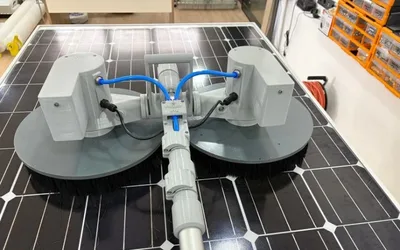
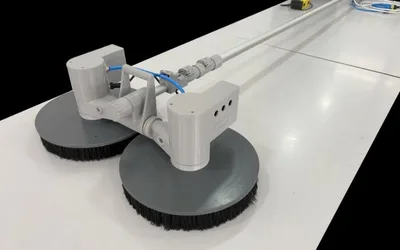
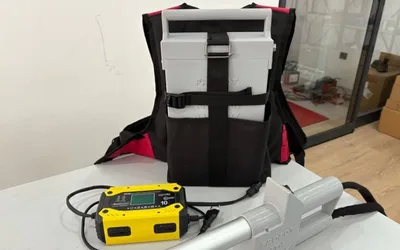
A motor-driven disc or roller brush sits at the end of a telescopic pole, with the battery usually carried in a backpack. The operator only guides the brush while the motor does the scrubbing. Frobot’s ATA DİSK35 twin-disc, ATA M60 single-roller and ATA M60 twin-roller brushes belong to this class. For a detailed comparison see choosing a solar panel cleaning brush.
4. Semi-automatic (remote-controlled) cleaning robot
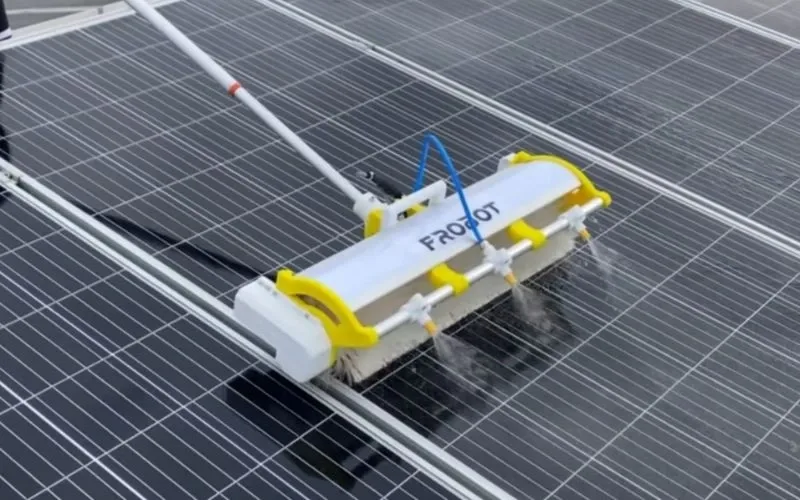
Portable machines placed on the panel row that travel on tracks and combine a cylindrical brush with water. The operator drives the robot from the ground with a remote, and one robot can be used on different rows and different sites. This is usually what people mean by a “solar panel washing robot”. We explain the working principle in how does a solar panel cleaning robot work.
5. Fully automatic rail system
Systems permanently mounted on each panel row that move on their own along a rail or the panel frame. They minimise human intervention, but each row needs its own unit and infrastructure, so the installation burden is high. They are generally considered for very large, regular sites and planned at the design stage.
Does pressure washing damage solar panels?
It is not pressurised water as such, but the wrong pressure and the wrong use that create risk. The problems most often seen on site are:
- Micro-crack risk: A high-pressure jet and sudden temperature change (cold water on hot glass) can contribute to invisible micro-cracks in the cells or to existing cracks growing. Over time these cracks come back as hot spots and lost production.
- Seal and edge damage: A jet held close to the frame edge, junction box and seals can drive water into the panel or its connection points.
- Coating wear: The anti-reflective coating on the glass can be affected by sandy water striking it at high pressure.
- Warranty problems: Panel manufacturers’ installation and maintenance manuals generally set limits on cleaning method, pressure and water temperature. Cleaning against these rules can make a warranty claim harder after damage. Always check your panel manual; more detail in does robotic cleaning affect solar panel warranty.
In short, if a pressure washer is used, low pressure, sufficient distance, cool hours and clean water are essential. Taking the mechanical action from a soft brush rather than from pressure is the safer approach for the panel. For other common mistakes, see solar panel cleaning mistakes to avoid.
Washing machine, brush and robot compared
| Equipment | Cleaning action | Capacity | Panel risk | Best-suited site |
|---|---|---|---|---|
| Pressure washer | Water pressure only; weak on sticky dirt | Medium | Micro-crack, seal and warranty risk at high pressure | Small areas with limited, careful use |
| Manual telescopic brush | Brush + water, operator-dependent | Low | Rises with dry rubbing and worn bristles | Very small roofs |
| Battery panel cleaning brush | Motorised brush + water, constant rotation | Medium | Low when used correctly | Homes, small to mid-size commercial roofs, areas a robot cannot reach |
| Remote-controlled cleaning robot | Cylindrical brush + water, constant pressure and speed | High | Low with the right brush and settings | Mid-size and large roofs, ground-mounted plants |
| Fully automatic rail system | Fixed brush system per row | Continuous per row | Depends on design | Very large, regular sites planned at design stage |
Which machine should you choose for your site size?
Homes and small roofs
On systems of a few dozen panels, the robot’s set-up and pack-down can take longer than the cleaning itself. At this scale a battery brush, or a cleaning service once or twice a year, is usually the most sensible choice. With its light weight and long runtime, the ATA M60 single-roller is designed for exactly this job.
Mid-size commercial and industrial roofs
As panel counts rise and rows get longer, the robot’s constant speed and capacity take the lead. For rooftops, the ATA 80 (33 kg excluding battery, 792 m²/h) is a good starting point with its light body, 0°–25° working tilt and ability to cross 25 cm gaps. A battery brush can complement it on edges and irregular areas the robot cannot reach.
Ground-mounted plants and large roofs
On long, regular rows, capacity becomes decisive. With its 120 cm brush and 2016 m²/h cleaning capacity, the ATA 120 is designed to finish large sites quickly; it works at 0°–20° tilt and across panel gaps of up to 50 cm. On ground-mounted sites, water supply, hose lines and crew planning matter as much as the machine; we cover this in ground-mount solar farm cleaning logistics.
What determines solar panel washing machine prices?
Quoting a single price would mislead, because machines sold under the same name belong to different classes. The main price factors are:
- Equipment class: Pressure washers, battery brushes, remote-controlled robots and rail systems sit at very different investment levels.
- Capacity and brush width: The more area cleaned per hour, the higher the machine cost.
- Battery type and count: LiFePO4 batteries, runtime and the need for a spare battery are reflected in the price.
- Options: Spare brushes, a bird-dropping scraper, an automatic spatula and similar choices.
- Warranty, service and spare parts: With local manufacturing, parts and service are quick to reach; with imported products, waiting time means days without cleaning.
- Price currency: Equipment prices are set in foreign currency, so the current amount can change with the daily exchange rate.
The current price of each Frobot product and the credit card instalment options are shown on its product page. We walk through the payback logic step by step in solar panel cleaning robot prices and return on investment.
What information should you prepare before choosing a machine?
Clarifying the following before talking to a supplier helps you pick the right class and compare quotations on the same basis:
- Total panel count and approximate panel area
- Installation type: home roof, industrial roof, ground-mounted or mixed
- Panel tilt, row lengths and gaps between rows
- Location of the water source, line pressure and water quality
- Soiling load in the region: dust, pollen, bird droppings, industrial particles
- Planned number of cleanings per year and who will do them
- How the robot or brush will be carried to site and where it will be stored
An assessment based on this list largely removes the risk of investing in a machine that does not fit the site. To set the cleaning frequency, see how often should solar panels be cleaned.
Buy a machine or buy a service?
On sites where one or two cleanings a year are enough, where no crew can be assigned and where there is nowhere to store equipment, buying a service is usually more economical. For operators with several sites, sites in dusty regions that need frequent cleaning, or their own maintenance team, owning a machine quickly makes sense. Many of our customers first buy a cleaning service, see the result on site and then decide on equipment.
Let us choose the right machine for your site together
Share your panel count, installation type, tilt and water source, and we will work out which option truly fits your site: washing machine, battery brush or robot. You can compare all equipment on our products page.
If you would rather leave the cleaning to us, our PV plant panel cleaning service operates across Turkey. For a quotation and technical advice, reach us through the contact page.
Frequently Asked Questions
Can solar panels be cleaned with a pressure washer?
They can, but low pressure, sufficient distance, clean water and cool hours are essential. High pressure carries micro-crack, seal and warranty risks, so the panel manufacturer’s manual should always be checked.
Is a solar panel washing robot the same as a cleaning robot?
In practice, yes. Both terms describe machines that travel along the panel row and clean with a brush and water; the Frobot ATA 120 and ATA 80 are remote-controlled robots in this class.
Which machine suits a small roof?
On homes and small roofs with a few dozen panels, a battery panel cleaning brush or a cleaning service is usually the most sensible choice. At this scale a robot’s set-up and pack-down can take longer than the cleaning.
Why do solar panel washing machine prices vary so much?
Products sold under the same name range from pressure washers to remote-controlled robots, and capacity, battery, options and service scope all change the price. The current price of Frobot products and credit card instalment options are shown on the product pages.
Can I see the result before buying a robot?
Yes. A cleaning service on your site lets you see the robot’s result and the production difference first-hand; many of our customers make their equipment decision this way.
Are your panels clean?
Buy our robots and brushes in credit card instalments, or request a quote for on-site cleaning.