Solar Panel Cleaning Robot Prices 2026 and Payback (ROI)
Frobot Technical Team · (updated)
In short: Solar panel cleaning robot prices depend on the model, brush width, hourly capacity, battery configuration and options. Because prices are set in foreign currency, the current price of the Frobot ATA 120 and ATA 80 and the credit card instalment options are shown on the product pages. The payback of the investment is the sum of recovered production and saved labour and service fees.
Solar panel cleaning robot prices are among the most frequently asked subjects. Quoting a single figure, however, would frame the question wrongly. The price of a robot changes with the model, the brush width, the capacity and the selected options. More importantly, the right question is not how much it costs but how long it takes for the investment to pay for itself.
In this article we explain the items that determine the price, the logic behind the payback calculation, and the points you should check when requesting a quotation.
Items that determine the robot price
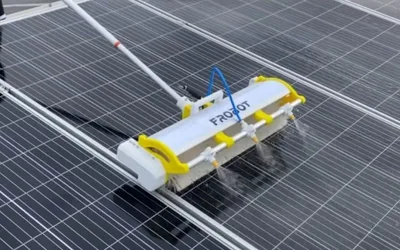
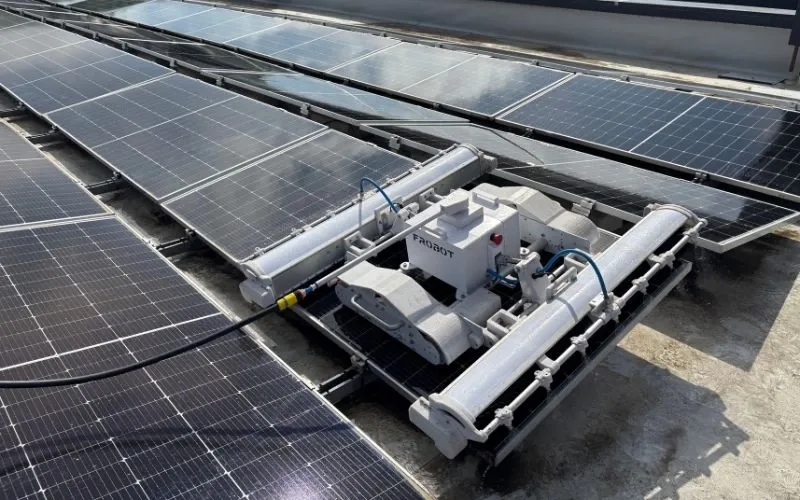
- Model and capacity: As the brush width and the cleaning area per hour grow, so does the cost of the machine. Our ATA 120 model, with a 120 cm brush and 2016 m²/h capacity, targets large sites, while the ATA 80, with 792 m²/h capacity and a light structure, is aimed at rooftop applications.
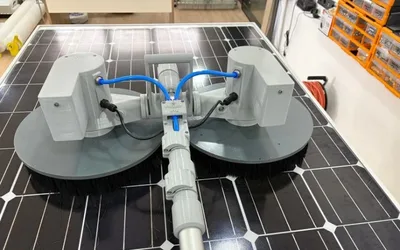
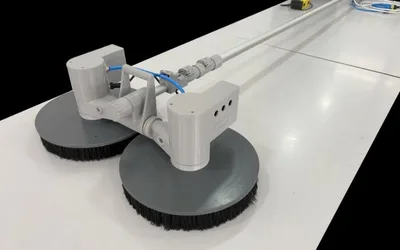
- Brush structure and length: The use of imported brushes and the production of custom-length brushes on request affect the price.
- Battery configuration: The LiFePO4 battery capacity and the spare battery option are reflected in the cost. On sites that need uninterrupted work, a spare battery is often a necessary item.
- Options: Choices such as the bird dropping scraper mechanism, the automatic spatula and spare brushes are added according to need.
- Consumables and service: This is the invisible part of the long-term cost. With locally manufactured equipment, access to spare parts and service is fast; with imported products, waiting times and supply risk push the cost up.
- Warranty scope: Our ATA 120 and ATA 80 models are covered by a 2-year warranty. The warranty period and its scope are a direct part of the total cost of ownership.
Robot prices are set in foreign currency and the local-currency amount is updated with the daily exchange rate. Rather than quoting a fixed figure, we recommend checking the ATA 120 and ATA 80 product pages, where the current price and credit card instalment options are shown. On configurations with options, the exact figure is set by a quotation for your site.
How should the return on investment be considered?
The return on a cleaning robot investment comes through two separate channels, and they need to be assessed together.
Channel 1: Recovered production
Efficiency loss caused by soiling is generally expressed in industry research as being in the 10 to 30 percent range. Regular cleaning recovers most of that loss. The logic of the calculation is:
- Determine the annual production of your site and the unit value the energy provides you.
- Apply the estimated loss rate that occurs when no cleaning is done.
- The resulting annual loss is the upper limit of what cleaning can earn you.
- Compare that amount with the robot investment.
The larger the site, the greater the monetary value of the recovered production. That is why a robot investment pays back faster as the scale grows.
Channel 2: Saved labour and service fees
The second channel is more concrete. If you have your site cleaned a few times a year, you are paying a service fee or a labour cost each time. Once you own a robot, that item largely disappears and is replaced by a much lower operating cost.
- Determine how many times a year you clean.
- Add up the current cost of each cleaning (labour, equipment rental or service fee).
- Calculate the cost of working with a robot (operator, water, electricity, maintenance).
- The difference is your annual saving.
The sum of the two channels shows in how many years the investment pays for itself. In practice this period varies markedly with site size, cleaning frequency and the soiling load of the region.
Do not forget to include
- Panel life: Regular cleaning reduces the risk of permanent hot spot damage. Avoiding an early panel replacement is a large gain that never appears directly in the table.
- Occupational safety: Keeping staff off the panels is an immeasurable gain, both in risk and in the cost of a possible accident.
- Time: Work that takes days with manual cleaning is shortened with a robot. Reducing operational interruption carries separate value in production facilities.
- Flexibility: When the robot is yours, you clean whenever you need to; your schedule is no longer tied to the calendar of a third party.
- Secondary use: You can use the equipment on other sites you own, and even turn it into a revenue item by offering a service.
What to check when requesting a quotation
Looking only at the number when comparing robot quotations from different suppliers is misleading. Two machines in the same price range can perform completely differently in the field. The following headings must be clear in a quotation:
- Cleaning area per hour (m²/h) and brush width
- Maximum working tilt and crossing distance between panels
- Battery type, running time on a single charge and spare battery option
- Weight excluding the battery and whether the machine is modular
- Package contents: how many brushes, remotes, chargers and accessories are supplied
- Warranty period and scope
- Spare part supply time and service point
A price comparison made before these items are clarified has no equivalent in the field.
Buy a robot or buy a service?
The needs of your site decide:
- A robot investment makes sense: when the site is large, when more than one cleaning a year is needed, when you have your own maintenance team, and when you own more than one site.
- Buying a service makes sense: when the site is small or mid-size, when one or two cleanings a year are enough, when you do not want to assign a team, and when you have nowhere to store equipment.
Because we at Frobot offer both, we can stay neutral in this decision. When we look at the data of your site, we recommend whichever option makes more sense.
If your site is small for a robot, a lower-budget equipment class is worth considering: see choosing a solar panel cleaning brush, and for a comparison of washing machines and robots, solar panel washing machine or cleaning robot?
Get a clear quotation for your site
Share your panel count, your installation type and the number of cleanings you plan per year, and we will work out both the right model and the payback table together. You can find the technical details on the ATA 120 (F120) and ATA 80 (F80) pages, and review all equipment options on our products page.
If you would rather leave the cleaning to us, learn about our PV plant panel cleaning service or request a quotation directly through the contact page.
Frequently Asked Questions
Why do solar panel cleaning robot prices change?
Robot prices are set in foreign currency, so the local-currency amount is updated with the daily exchange rate. Model, brush width, battery configuration and options also affect the price; the current amount is always shown on the product page.
Can I pay for the robot in credit card instalments?
Yes. Credit card instalment options are shown on the ATA 120 and ATA 80 product pages. For configurations with options, you can request a quotation through the order page or our contact channels.
What is the operating cost of the robot?
The main items are water, electricity for charging the battery, consumables such as brushes, and operator time. Water consumption is stated as roughly 350 l/h for the ATA 120 and roughly 300 l/h for the ATA 80.
Why is a locally manufactured robot an advantage?
The real difference lies in service and spare parts. With imported equipment the wait for a part can stretch into weeks; Frobot robots are locally manufactured, all consumables and service are available, and they carry a 2-year warranty.
Can I see the result before buying?
Yes. Many of our customers first buy a cleaning service for their site, see the robot at work and the production difference on the spot, and then decide on the investment.
Are your panels clean?
Buy our robots and brushes in credit card instalments, or request a quote for on-site cleaning.