Water Quality in Solar Panel Cleaning: A Practical Guide
Frobot Technical Team ·
Most conversations about solar panel cleaning revolve around brushes and machines. In the field, though, the factor that most often ruins a job is not the brush at all: it is the water. A clean performed with the right brush, at the right pressure and at the right hour can still leave an array covered in chalky white spots if the water is wrong. Those spots scatter light, cost output, and get harder to remove with every wash.
This guide covers what pure and demineralised water actually mean, how TDS and hardness are measured, how reverse osmosis and DI resin work, when mains water is good enough, and how to cut water consumption on site.
Why hard water leaves spots on glass
The calcium, magnesium and other dissolved solids in water do not disappear when the water evaporates. They stay on the glass. Because module surfaces dry quickly in the sun, those minerals settle as a thin crust and form visible white marks. The panel has just been washed, yet the deposit scatters part of the incoming light, so the production gain you expected never materialises.
The real problem is that the crust hardens over time. Each wash adds another mineral layer, and beyond a certain point normal brushing no longer removes it. That is when people start considering aggressive methods that put the glass and its coating at risk, which is one of the most expensive cleaning mistakes there is.
Pure, demineralised, deionised: what the terms mean
These terms are used loosely in the field, but they share one idea: dissolved minerals have been removed from the water.
- Demineralised water: dissolved mineral salts largely stripped out.
- Deionised (DI) water: passed through ion exchange resin to remove cations and anions.
- Pure water: the everyday field term for water low enough in minerals to leave no visible residue.
The practical advantage is simple: pure water dries spot free. With nothing dissolved in it, evaporation leaves nothing behind, so the glass dries clean without wiping or squeegeeing. Water stripped of minerals also bonds more readily to surface soiling and lifts residue without any detergent at all.
TDS and hardness: what to measure
Two indicators cover almost every situation. TDS (total dissolved solids) tells you how much dissolved material the water carries and reads in seconds on an inexpensive handheld meter. Hardness describes the calcium and magnesium load, and that is what drives spotting.
The rule of thumb is straightforward: the lower the TDS, the cleaner the panel dries. Measuring your intended source before mobilising is the cheapest way to avoid a disappointing result. Even within one region, well water and mains water differ dramatically.
Reverse osmosis and DI resin
Reverse osmosis (RO)
Reverse osmosis pushes water through a semi-permeable membrane under pressure, removing most dissolved solids. On high-TDS supplies it is the first and most economical treatment stage. The trade-offs are concentrate waste water and periodic membrane maintenance.
DI resin
Ion exchange resin captures the ions remaining after RO and brings the water to a genuinely residue-free level; when exhausted it is replaced or regenerated. Feeding hard water straight into resin works, but it saturates very quickly, so running RO ahead of DI gives a cleaner result at a lower running cost.
A typical field installation runs: sediment pre-filter, activated carbon for chlorine removal, reverse osmosis, DI resin, clean water storage tank.
When is mains water good enough?
Not every site needs treated water. If the mains supply is low in TDS and hardness and the glass is not baking hot, mains water gives perfectly good results. Plenty of plants in soft-water regions have been cleaned this way for years.
Where mains water fails is equally clear: high hardness, midsummer conditions with very fast drying, dark frames where spotting shows immediately, and installations where the client expects a flawless finish. There, treated water is a requirement rather than a luxury.
Why well water carries risk
Well water is tempting because it is free and on site, but it is the riskiest source. High calcium leaves permanent limescale marks, while dissolved iron produces yellow-brown rust staining that is extremely hard to remove from glass. Suspended sand is a separate hazard: it lodges in brush bristles and scratches. If well water must be used, filter the sediment and measure TDS first.
Water consumption and how to reduce it
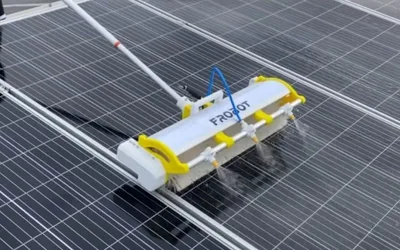
Water is the heaviest logistical item on ground-mount sites, because it has to be hauled, stored and pumped, which makes flow rates worth knowing when you specify equipment. The ATA 120 (F120) uses approximately 350 litres per hour through 14 stainless steel 110-degree nozzles, while the ATA 80 (F80) uses approximately 300 litres per hour through 10 stainless 110-degree nozzles. Both figures feed directly into tanker sizing and daily planning.
Practical ways to reduce consumption on site:
- Pre-wet and dwell: on bonded soiling a short soak uses less water than blasting straight through it.
- Work the cool hours: surfaces dry more slowly, so the same job takes less water.
- Maintain the nozzles: blocked or worn nozzles distribute flow unevenly and waste water.
- Sequence with the wind: this prevents re-soiling and re-washing panels you already cleaned.
- Store on site: a buffer tank saves both tanker trips and spillage.
Why detergent is usually a bad idea
Detergent on module glass looks convenient and creates three problems. First, incomplete rinsing leaves a film that holds dust, so the array re-soils faster than before. Second, many detergents attack the anti-reflective coating and frame seals over time. Third, some manufacturers exclude certain chemicals in their warranty conditions.
Solve soiling mechanically and through water quality rather than chemistry. A soft brush, controlled flow and mineral-free water already deliver everything detergent claims to add. Our article on warranty and robotic cleaning covers the warranty side.
Frequently asked questions
Can panels be cleaned without pure water?
Yes. If your supply is soft and the surface is not drying instantly, mains water works well. Pure water makes the difference on hard supplies and where a flawless finish is expected.
Can existing limescale marks be removed?
A recently formed thin layer improves substantially after a few passes with pure water and a soft brush. Hard crusts built up over years need a case-by-case assessment, and abrasive pads must never be used on the glass.
Should we buy distilled water?
At plant scale, buying distilled water is not economical. Producing treated water on site with an RO and resin combination is far cheaper.
How do we plan water use for robotic cleaning?
Multiply hourly flow by planned working hours: roughly 350 litres per hour for the ATA 120 and roughly 300 for the ATA 80.
Clean with the right water and the right equipment
Frobot robots and battery brushes are built around controlled flow and soft brushes that suit module glass. Review the full range on our products page.
Tell us about your water source, its hardness and your array layout, and we will help you specify both the equipment and the treatment setup. If you would rather outsource the work, ask about our PV cleaning service through the contact page.
Are your panels clean?
Buy our robots and brushes in credit card instalments, or request a quote for on-site cleaning.