Ground-Mount Solar Farm Cleaning Logistics: A Field Guide

Frobot Technical Team ·
On a ground-mount solar farm, washing the glass is not the hard part. The hard part is getting the right equipment to the right row at the right hour, delivering enough water to it, and finishing the day within the limits set by ground conditions, module temperature and wind. Past a certain size, cleaning becomes a logistics job.
This guide covers that logistics problem: site access, mud and soft ground, water supply and storage, pumps and hoses, crew and shift design, row sequencing, temperature limits, safety, and daily throughput planning with robots.
Site access and tracks
Planning starts at the gate, not at the panel. Know in advance which blocks a bowser or pickup can reach, what the turning radii are and where the crossing points sit. Every metre a vehicle cannot cover is a metre that equipment and water get carried by hand, straight out of daily throughput.
A site survey should record gate width and key-holder responsibility, the load capacity of the main track, whether inter-row ground will carry a vehicle, the nearest filling points, and where equipment can be left overnight.
Mud and soft ground
The most common problem after rain is a bogged-down vehicle. The rule is simple: no heavy vehicles in the array the day after significant rainfall. On those days water is run in by hose from a bowser parked on firm ground at the site edge, or drawn from a buffer tank filled in advance.
Soft ground carries a second risk: mud splash. Mud thrown onto cleaned modules by a passing vehicle means re-washing that row, so route the vehicle through blocks not yet cleaned.
Water supply and storage
Water is the backbone of the plan. There are four typical sources, each with its own constraint:
- Tanker or bowser: flexible everywhere, but round-trip time to the filling point sets your daily ceiling.
- Well: cheap and on site, yet sediment, iron and calcium make filtration and a TDS check essential.
- Mains: predictable quality, but flow rate may not keep up with a robot in continuous use.
- On-site buffer tank: fills slowly overnight, covers high daytime demand and cuts tanker trips.
Sizing the tank requires hourly consumption figures. The ATA 120 (F120) uses approximately 350 litres per hour and the ATA 80 (F80) approximately 300. For the quality side, see our guide to water quality in solar panel cleaning.
Pumps and hose layout
A large share of the day disappears into laying out and recovering hose, so hose length and pump capacity must be specified together: a long run costs pressure, a short run forces constant vehicle repositioning.
The layout that works best is a fixed spine line along the main axis, with short flexible branches into the block being worked, and a hose reel measurably shortens the day. Route lines so they never cross a vehicle track, which eliminates crush damage and burst-line stoppages.
Crew planning and shift design
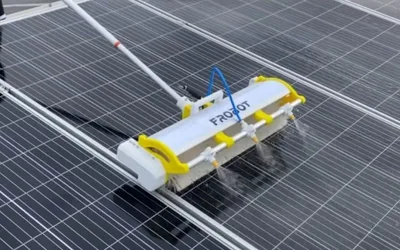
A robot-based crew is structured differently from a manual one: one operator driving the robot by remote, one person moving and positioning it on the next row, one managing the water line and pump. Equipment weight translates directly into throughput: the ATA 120 weighs 53 kg excluding batteries and runs on two 7 kg packs, while the ATA 80 weighs 33 kg with a 4 kg battery.
Battery runtime shapes the shift. The ATA 120's LiFePO4 pack gives 3 to 3.5 hours and the ATA 80 gives 2.5 to 3 hours per charge. Running a spare set is the simplest way to finish a day without a break: one set is on the array while the other is on charge.
Row sequencing: do not re-soil what you cleaned
The most frequent mistake on ground-mount sites is cleaning rows in a random order, or in order of convenience. The result is cleaned modules re-soiled by vehicle dust, overspray or mud splash.
- Work downwind: keeps overspray and dust off rows you have already finished.
- Leave the vehicle route until last: rows beside the unpaved track are the final job of the day.
- Close out block by block: finish one block before moving on, rather than jumping around.
- Keep the water line behind you: dragging hose across cleaned rows soils them and risks damage.
Irradiance peaks and module temperature
In summer, glass temperatures climb sharply around midday. Watering hot modules creates thermal shock risk, and the water flashes off within seconds leaving mineral spotting behind. The practical working window is early morning and late afternoon.
There is a production argument too: cleaning shades part of the array while it happens, and doing that at peak irradiance wastes generation. Use the midday break for rest, battery swaps, refilling and equipment checks.
Safety
Three risks dominate: electrical hazards, manual handling injuries and weather. On the electrical side the rule is absolute: do not work with water anywhere you can see a damaged cable, a cracked module or an exposed connector; report it to the site owner first.
Lifting a robot from row to row is a two-person task. Clear the site if there is any lightning risk, and secure light equipment and hose in strong wind. On wet ground, cables and hoses are a trip hazard, so keep walking routes clear.
Daily throughput planning
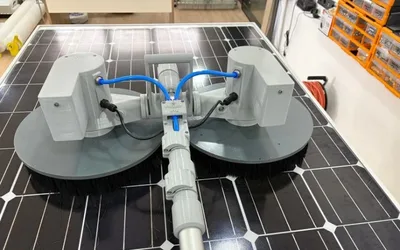
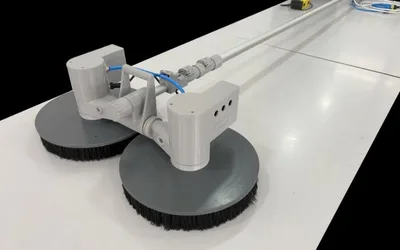
Throughput planning starts from nominal machine capacity. The ATA 120 (F120) cleans 2016 m² per hour, with a 120 cm imported brush, 0-28 m/min working speed, 0 to 20 degree working tilt, 50 cm inter-panel gap crossing and a 9-channel Radiolink remote. The ATA 80 (F80) cleans 792 m² per hour, with two 80 cm brushes, 0-22 m/min, 0 to 25 degree tilt and 25 cm gap crossing. Both carry a 2-year warranty.
For a realistic plan, subtract from nominal capacity: positioning the robot on each row, setting up hose and pump, battery swaps, the midday heat break and travel within the site. We cover how to turn those hours into a budget in our article on calculating cleaning cost.
Frequently asked questions
How many hours a day can a crew work on a field site?
In summer, temperature limits split the day into morning and late-afternoon windows. In spring and autumn full-day working is realistic. Battery capacity and the number of spare packs also set the ceiling.
What is the best way to get water onto site?
On larger sites, a buffer tank that fills overnight removes any dependence on tanker round trips during the day and eliminates crew waiting time.
Can we clean after rain?
If the ground will carry a vehicle, yes, and damp soiling actually lifts more easily. If the ground is too soft to enter, postpone.
Which robot suits a ground-mount site better?
On large sites with long, regular rows the ATA 120 wins on throughput. On smaller or fragmented sites the lighter ATA 80 is more practical.
Let us plan your site together
Frobot both supplies equipment for ground-mount solar farms and delivers professional cleaning services. See our field work on the gallery page.
Share your site size, mounting layout and water source, and we will work out daily throughput, crew size and the water plan with you. You can reach us through the contact page.
Are your panels clean?
Buy our robots and brushes in credit card instalments, or request a quote for on-site cleaning.