How Does a Solar Panel Cleaning Robot Work? (2026 Guide)
Frobot Technical Team ·
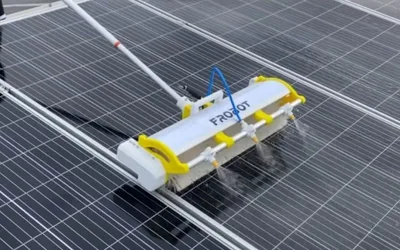
In short: A solar panel cleaning robot is a field machine placed on top of a panel row that travels across the glass on rubber tracks and removes dust and dirt with a rotating cylindrical brush combined with water from spray nozzles. The operator drives it from the ground with a remote control, adjusting travel speed, water flow and brush height. Staff stay off the panels while a large area is cleaned quickly and to the same standard everywhere.
When people hear “solar cleaning robot”, many picture a fully autonomous device that roams on its own. The reality on site is more practical: on rooftop and ground-mounted plants in Turkey, the most widely used type is a portable, tracked cleaning robot driven by an operator with a remote. This guide explains which parts a solar panel cleaning robot consists of, how it works on site step by step, how it differs from manual cleaning and pressure washers, and the technical values with which the Frobot ATA 120 and ATA 80 do the job.
What parts does a solar panel cleaning robot consist of?
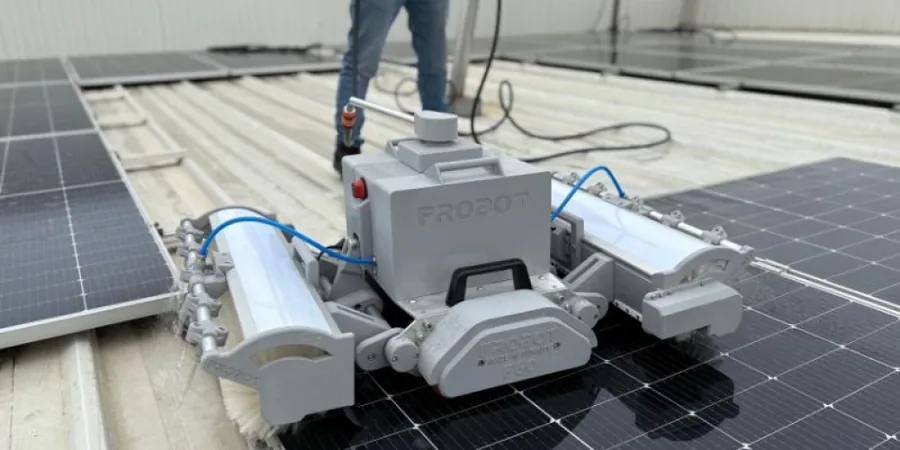
Details vary between models, but a remote-controlled panel cleaning robot is built around five core systems:
- Chassis and tracks: The body sits on the panel row. It moves on rubber tracks that do not harm the glass and grip on a slope. Because tracks spread the weight over a wide area, they press on the surface more evenly than wheels.
- Cylindrical brush: Rotating horizontally at the front or underside of the robot, the brush loosens dust, pollen film and dry residue. Its width sets the strip cleaned in a single pass.
- Water and nozzle line: Water delivered by hose from the site supply is sprayed onto the surface through nozzles ahead of the brush. It carries away the loosened dirt and stops the brush from dragging dry dust across the glass.
- Power system: The track motors and brush motor run on a rechargeable battery on the robot. Frobot robots use LiFePO4 (lithium iron phosphate) batteries.
- Remote and control: With a multi-channel remote the operator controls forward and reverse travel, turns, water on/off and brush height. A voltage indicator lets the crew follow battery status on site.
How does a solar cleaning robot work on site, step by step?
A cleaning day follows largely the same flow regardless of robot type:
- Site check: Panel tilt, gaps between rows, the location of the water supply and the weather are checked. No work is done in strong wind, on frosted surfaces or at midday when the panels are very hot.
- Set-up: The modular robot is carried to the site, assembled if needed, the batteries are fitted and the water hose is connected.
- Placing it on the panels: The robot is placed safely onto the surface at one end of the row. With heavier machines this is a two-person job on most sites.
- Cleaning pass: The operator opens the water, starts the brush and drives the robot towards the end of the row. Speed is lowered or raised with the soiling level, and stubborn areas get a second pass.
- Crossing between panels: If the gap between panels is within the robot’s crossing distance, it moves to the next panel on its own tracks. With wider gaps or at the end of a row, it is lifted to the next row.
- Battery management: When the voltage drops, a spare battery is fitted so work continues without waiting for a charge.
- Wrap-up: The water is shut off, the robot is taken down, brush and nozzles are cleaned, batteries go on charge and the cleaned rows are logged.
The key outcome of this flow is that cleaning quality does not depend on operator fatigue. Brush pressure and travel speed are the same at the start of the row as at the end.
How do the brush and water clean together?
Most soiling on panel glass clings too firmly to be rinsed off by water alone. Pollen film, dust stuck by moisture and dried, hardened residue need mechanical action. On the robot that action comes from the rotating brush, while water does two jobs: it carries dirt away and stops sand grains from being rubbed dry across the glass.
Water quality therefore affects the result. Hard water can leave lime marks as it dries. We cover water choice and treatment in detail in our article on water quality in solar panel cleaning. As a general rule, no detergent or chemicals are used on panels; the right brush and clean water are enough for most soiling types.
Sticky, dried stains such as bird droppings do not always come off with a single brush pass. For such sites some robots carry extra mechanisms such as a scraper attachment. You can read about the effect of different soiling types in types of solar panel soiling and their effects.
Why doesn’t the robot slip on tilted panels?
Safe work on a slope depends on three things: the track surface material, the weight distribution and the working tilt limit stated by the manufacturer. Flexible rubber tracks grip glass well without scratching it. Every robot has a safe tilt limit, however, and it should not be used on structures steeper than that. Measuring the site tilt is therefore the first step before choosing a model.
The gap between rows is just as decisive. Where gaps exceed the robot’s crossing distance, the machine must be carried by hand. That does not make cleaning impossible, but it lowers daily capacity and changes the crew plan.
What is the difference between a robot, manual cleaning and a washing machine?
The table below summarises the three methods most often compared on site:
| Criterion | Cleaning robot | Manual brush / mop | Pressure washing machine |
|---|---|---|---|
| How it works | Travels on the panels on tracks, cleans with brush + water | Operator brushes by hand with a telescopic pole | Washes with a high-pressure water jet |
| Capacity | High; a clear advantage on large sites | Low; depends on operator pace | Medium; slows down on sticky dirt without mechanical action |
| Staff on the panels | Not required | May be required depending on access | May be required depending on access |
| Consistency of cleaning | Constant pressure and speed, uniform result | Drops with fatigue | Varies with distance and angle |
| Risk to glass and seals | Low with the right brush and settings | Rises with dry rubbing and worn bristles | High pressure is risky for seals, edges and cells |
| Water use | Controlled; switched on/off from the remote | Low to medium | Depends on nozzle and pressure, often high |
| Suitable site | Mid-size and large roofs, ground-mounted plants | Small roofs, areas a robot cannot reach | Small areas with limited, careful use |
We explain why pressure washing calls for caution regarding panel warranty and micro-cracks, and which machine suits which site, in solar panel washing machine or cleaning robot?
How do the Frobot ATA 120 and ATA 80 work?
Frobot robots are remote-controlled, tracked cleaning robots manufactured entirely in our facility in Ordu, Turkey. Both models are modular, easy to carry to site and quick to assemble. They work exactly as described above; the differences lie in capacity, weight and site fit.
ATA 120 (F120): for large sites
- 120 cm imported cylindrical brush, 15 cm brush diameter
- 0–28 m/min working speed and 2016 m²/h cleaning capacity
- 3–3.5 hours of work on LiFePO4 batteries; 2 batteries of 7 kg each
- 0°–20° working tilt, 50 cm panel-to-panel crossing distance
- About 350 l/h water consumption, 14 stainless 110° nozzles
- 9-channel RadioLink remote; water on/off and brush height adjustment from the remote
- 53 kg excluding batteries, rubber flex tracks, 2-year warranty
- Options: spare battery, spare brush, remote-controlled bird-dropping scraper
On ground-mounted plants and large industrial roofs with long, regular rows, the ATA 120 solar panel cleaning robot stands out.
ATA 80 (F80): for roofs and tighter areas
- 80 cm brush, 15 cm brush diameter, 130 W brushless motor technology
- 0–22 m/min working speed and 792 m²/h cleaning capacity
- 2.5–3 hours of work on a LiFePO4 battery; battery weight 4 kg
- 0°–25° working tilt, crossing gaps of 25 cm and above
- About 300 l/h water consumption, 10 stainless 110° nozzles
- 9-channel RadioLink remote; water on/off and brush height adjustment from the remote
- 33 kg excluding battery, rubber flex tracks, 2-year warranty
With its lighter body and higher tilt tolerance, the ATA 80 solar panel cleaning robot works comfortably on rooftops and on sites with limited access. We compare the two models criterion by criterion in how to choose a solar panel cleaning robot.
The current price of both robots and the credit card instalment options are shown on the product pages. For the cost and payback logic, see solar panel cleaning robot prices and return on investment.
Where does a robot not work, or not pay off?
- Tilt above the limit: Safe work is not possible on roofs steeper than the robot’s stated working tilt.
- Highly fragmented layout: Short, scattered panel groups facing different directions mean constant carrying; a battery brush is more efficient on such roofs.
- No safe way onto the panels: If lifting and placing cannot be planned, the robot should not be used.
- No water supply: Brush and water work together, so the site needs a water connection or a tanker plan.
- Very small area: On a few dozen panels, set-up and pack-down can take longer than the cleaning itself.
In these cases a battery-powered solar panel cleaning brush or a professional cleaning service is the better choice.
What should you watch when using a robot?
- Clean in the early morning or late afternoon while the surface is cool; avoid putting cold water on hot glass.
- Set the brush to the right height for the panel surface and replace worn brushes in time.
- Keep the water on only while cleaning; remote water control prevents needless consumption.
- Charge and store batteries as the manufacturer recommends; use a dry store in winter.
- Clean the tracks and nozzles after every job. For routine steps see our cleaning robot maintenance guide.
Let us choose the right robot for your site together
Share your panel count, installation type, tilt and row gaps, and we will work out how a robot would operate on your site and which model fits. You can review all robot and battery brush options on our products page.
If you want to see the result before buying, or would rather leave the cleaning to us, learn about our PV plant panel cleaning service; for a quotation and technical advice, reach us through the contact page.
Frequently Asked Questions
Does a solar panel cleaning robot work automatically?
The portable robots most widely used on site are driven by an operator from the ground with a remote control. The Frobot ATA 120 and ATA 80 are also operated with a 9-channel remote, with water flow and brush height adjusted from the remote.
Can a cleaning robot damage the panels?
A robot working with the right brush, clean water and the correct brush height does not harm the glass. Rubber tracks grip without scratching; risk mostly comes from worn brushes and dry rubbing.
How much area does a robot clean per hour?
The stated cleaning capacity is 2016 m²/h for the Frobot ATA 120 and 792 m²/h for the ATA 80. Actual time on site depends on row layout, crossings between rows and soiling level.
Does a cleaning robot use water?
Yes, the brush and water work together. The ATA 120 uses about 350 l/h and the ATA 80 about 300 l/h, and the water can be switched on and off from the remote.
On what tilt can the robot work?
The working tilt is 0°–20° for the ATA 120 and 0°–25° for the ATA 80. On roofs steeper than that, a battery brush or a cleaning service is recommended.
Are your panels clean?
Buy our robots and brushes in credit card instalments, or request a quote for on-site cleaning.