Solar Panel Cleaning Brush: Telescopic or Battery-Powered?
Frobot Technical Team ·
In short: Solar panel cleaning brushes come in three main classes: manual telescopic brushes, battery-powered disc brushes and battery-powered roller (cylinder) brushes. A telescopic brush is enough for occasionally cleaning a few panels; on home and commercial roofs cleaned regularly, a battery brush is both faster and more consistent. Once the panel area grows and cleaning becomes more frequent, moving to a cleaning robot makes sense.
A search for “solar panel cleaning brush” brings very different needs together: a homeowner with a few panels on the roof and a maintenance crew serving dozens of roofs type the same words. Yet they do not need the same brush. This article covers the types of panel cleaning brush, selection criteria such as bristle type and water supply, the technical differences between Frobot’s three battery brushes, and when moving to a robot makes sense.
What types of solar panel cleaning brush are there?
Manual telescopic brush
A fixed-bristle brush head sits at the end of an extendable pole; on most models water is fed to the brush through the pole or a connected hose. The investment is low and use is simple. However, all the scrubbing comes from the operator’s arm. After a few dozen panels the pressure drops, passes become patchy and cleaning quality falls. A long pole also tires the operator quickly, especially when reaching from an edge.
Battery-powered disc brush
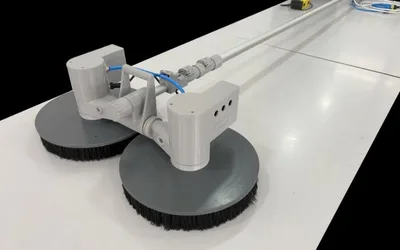
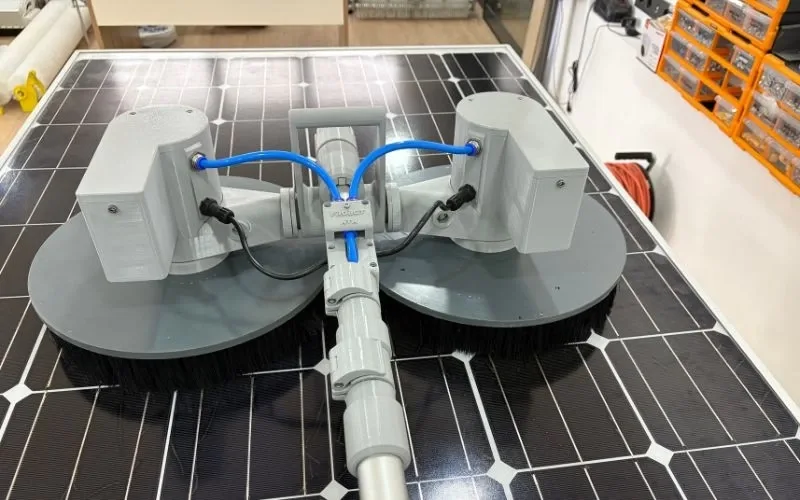
One or two motor-driven discs sit at the end of the pole. The disc motion creates a circular scrubbing action on the surface, which makes a difference on sites with sticky soiling, pollen film and agricultural dust. The battery is usually carried in a backpack.
Battery-powered roller (cylinder) brush
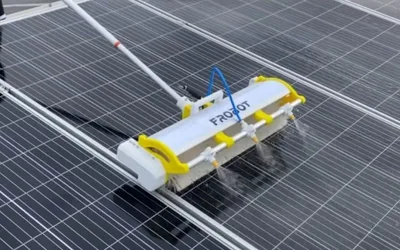
A cylindrical brush rotates on a horizontal axis at the end of the pole. It works much like the brush on a cleaning robot: the roller cleans in a straight strip along the panel and makes regular passes over wide surfaces easy. Single- and twin-roller models exist; a twin roller covers more surface per pass.
Telescopic, battery disc and battery roller brushes compared
| Criterion | Manual telescopic brush | Battery disc brush | Battery roller brush |
|---|---|---|---|
| Scrubbing power | Operator’s arm | Motorised, circular scrubbing | Motorised, cylindrical strip cleaning |
| Consistency | Drops with fatigue | Constant rotation, uniform | Constant rotation, regular strips |
| Strongest against | Light dust | Sticky dirt, pollen film, agricultural dust | Dust and general soiling on wide surfaces |
| Operator fatigue | High | Low to medium | Low to medium |
| Suitable site | A few panels, occasional cleaning | Heavily soiled roofs and sites | Homes and small to mid-size commercial roofs |
| Frobot model | — | ATA DİSK35 | ATA M60 single / ATA M60 twin roller |
Frobot battery-powered panel cleaning brushes
Like our robots, Frobot brushes are manufactured locally in our facility in Ordu, Turkey, with consumables and service support available domestically. The key features of the three models are:
ATA DİSK35 – battery-powered twin-disc brush
- Twin-disc design with a wide contact area on the surface
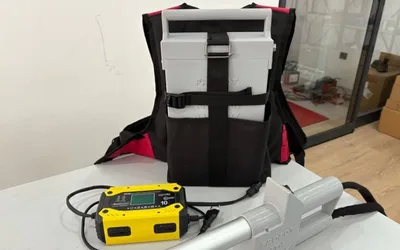
- LiFePO4 battery and battery backpack
- 4–6 hours of uninterrupted work thanks to battery operation
- Package: twin-disc brush, LiFePO4 battery, charger, battery backpack
For roofs and sites with heavy sticky soiling, see the ATA DİSK35 battery-powered twin-disc solar panel cleaning brush.
ATA M60 single roller – battery-powered single-roller brush
- 50 cm brush length, 4.5 kg weight
- Telescopic pole extending from 2 to 6 m
- Per the specification table, up to 9–10 hours of use on a single LiFePO4 battery
- 1.5 kg battery, easy to carry in the backpack
- Modular design with easily replaceable parts; 1-year warranty against manufacturing defects
Its light weight makes it ideal for home roofs and areas where a robot cannot work: ATA M60 battery-powered single-roller solar panel cleaning brush.
ATA M60 twin roller – battery-powered twin-roller brush
- 60 cm brush length, 4.5 kg weight
- Telescopic pole extending from 2 to 6 m
- 3–4 hours of use on a single LiFePO4 battery
- 4.5 kg battery carried in the backpack
- Modular design; 1-year warranty against manufacturing defects
On roofs with more panels, the ATA M60 battery-powered twin-roller solar panel cleaning brush covers a wider surface per pass.
The current price of all three brushes and the credit card instalment options are shown on the product pages.
What should you look for when choosing a brush?
Bristle type and stiffness
Panel glass and its anti-reflective coating are not suited to stiff or metal-containing bristles. Choose soft, flexible bristles made for panel cleaning. Bristles wear over time, their tips harden or sand gets trapped in them; the brush head must then be replaced. Worn bristles are one of the main causes of scratch complaints on site.
Water supply and water quality
A brush should never be rubbed over dry dust. Wet the surface first and keep water flowing while brushing. Before buying, confirm how the brush connects to your hose set-up on site and whether your line pressure is sufficient. Water quality matters too, since hard water can leave marks as it dries; details in water quality in solar panel cleaning.
Pole length and weight
The telescopic pole lets the operator reach the panels from the roof edge or a safe position. On a long pole the weight of the brush head is felt quickly, so a light head and a design that carries the battery on the back make a clear difference over a full day.
Battery and runtime
Your daily plan depends on how long you can work on one charge. For crews working long shifts, battery capacity and the option of a spare battery matter as much as brush width.
Service and spare parts
On a motorised brush, the motor, battery and brush head need maintenance over time. A product whose parts you cannot get quickly may sit in storage in the middle of the cleaning season. A modular, locally manufactured design reduces that risk.
How do you clean a roof with a battery brush, step by step?
- Preparation: Check the weather; do not work in wind, frost or very hot hours. Decide on a safe working position and the water line.
- Connection: Put the battery in the backpack, fit the brush to the pole, set the pole to a length that reaches the panels comfortably and connect the water.
- Pre-wetting: Wet the surface of the row first; dry dust and sand soften at this stage.
- Brushing: Start the brush and clean the panel from the top edge downwards in regular, slightly overlapping strips. Do not press the brush onto the surface; the motor does the scrubbing.
- Rinsing: Carry the loosened dirt away with clean water and move on to the next row.
- Wrap-up: Rinse the brush, clear sand from the bristles, put the battery on charge and note the rows cleaned.
What to watch when cleaning with a brush
- Clean in the early morning or late afternoon while the surface is cool.
- Never step or walk on the panels; use proper safety equipment on roofs. See rooftop solar panel cleaning for details.
- Do not use detergents or chemicals; clean water and the right brush are enough for most dirt.
- Rinse the brush at the end of the job and never move to the next panel with a sandy head.
- Soak dried stains such as bird droppings first, then brush.
When should you move from a brush to a cleaning robot?
A battery brush works at the operator’s pace. These signs show that a robot now makes more sense:
- The panel area has grown and a single cleaning takes days.
- Rows are long and regular, and the tilt is within the robot’s working limit.
- Cleaning frequency has risen because the region is dusty.
- You serve several sites and labour costs are growing.
At that point the ATA 80 (792 m²/h, 0°–25° tilt) can be considered for rooftops and the ATA 120 (2016 m²/h, 120 cm brush) for large roofs and ground-mounted sites. Many professional crews use both: the robot cleans the main surface while a battery brush finishes edge rows and sections the robot cannot reach. We discuss the decision criteria in battery brush or robot?, and give a broader comparison of equipment classes in solar panel washing machine or cleaning robot?
Let us choose the right brush together
Share your panel count, roof type and soiling conditions, and we will work out whether a telescopic, disc or roller brush suits your site. You can review all brush and robot options on our products page.
If you would rather leave the cleaning to us instead of buying equipment, learn about our cleaning services; for any questions, reach us through the contact page.
Frequently Asked Questions
Does a solar panel cleaning brush scratch the panels?
Not with a soft-bristled, clean brush and plenty of water. Scratch risk mostly comes from worn bristles, sand trapped in the brush and rubbing a dry surface.
Should I buy a telescopic brush or a battery brush?
A telescopic brush is enough for occasionally cleaning a few panels. On home and commercial roofs cleaned regularly, a battery brush delivers faster and more uniform results thanks to its constant rotation.
How long does a battery panel cleaning brush run?
The Frobot ATA DİSK35 is stated to run 4–6 hours without interruption. The ATA M60 single roller’s specification table lists up to 9–10 hours on a single battery, and the ATA M60 twin roller 3–4 hours.
How far does the telescopic pole extend?
The Frobot ATA M60 single and twin roller brushes come with a telescopic pole extending from 2 to 6 m. This lets you reach the panels from the roof edge or a safe position.
When should I move from a brush to a robot?
A robot becomes more efficient once the panel area grows and cleaning takes days, and the rows are long with a suitable tilt. The ATA 80 can be considered for rooftops, and the ATA 120 for large roofs and ground-mounted sites.
Are your panels clean?
Buy our robots and brushes in credit card instalments, or request a quote for on-site cleaning.