Does Robotic Cleaning Affect Your Solar Panel Warranty?

Frobot Technical Team ·
Whenever panel cleaning comes up, plant owners tend to ask the same question first: will this void my warranty? The question is fair. Much of a solar module's value sits not in its glass but in the long-term commitment printed on the manufacturer's warranty document, and a careless cleaning method can put that commitment at risk.
The short answer is that cleaning done correctly does not void a warranty. Most manufacturers in fact treat regular cleaning as part of the owner's maintenance duty. What endangers the warranty is not cleaning itself but the pressure applied, the chemicals used, the mechanical load placed on the module and the time of day the work is done. This article breaks that distinction down.
What does a panel warranty actually cover?
A solar module is normally sold with two separate commitments. Confusing them is the most common mistake in warranty disputes.
Product warranty (materials and workmanship)
The product warranty covers the glass, frame, backsheet, junction box and solder joints against manufacturing defects. Delamination from a production fault or a junction box separating from the module falls inside this cover. Damage from external forces, faulty installation or improper maintenance falls outside it.
Performance warranty (power output)
The performance warranty promises that the module will not drop below a defined share of its nameplate power after a defined number of years. The critical point is what happens when you file a claim: the manufacturer investigates whether the drop comes from natural degradation or from an external cause. Losses traced to soiling or to incorrect cleaning are not covered and can be grounds for rejecting the claim.
What typically voids a warranty?
Wording varies between brands, but the exclusion headings repeat across the industry:
- Abrasive treatment of the glass: stiff brushes, metal scrapers, scouring cloths or powders.
- Unsuitable chemicals: strongly alkaline or acidic cleaners and solvents, which can permanently damage the anti-reflective coating.
- High-pressure washing: almost every manufacturer defines a maximum pressure, and exceeding it is an explicit exclusion.
- Standing or placing weight on modules: walking on the glass, resting ladders or tools on it.
- Hard water and mineral residue: water that leaves scale or salt film behind. We cover this in detail in our guide to water quality in panel cleaning.
- Thermal shock: cold water applied to a module heated by midday sun.
Micro-cracks: the risk you cannot see
Micro-cracks are fine fractures inside the silicon cell that are invisible to the naked eye. The glass still looks intact and the module keeps producing, but the current-collecting paths inside the cell are partly broken.
How they form
- Mechanical load: standing or kneeling on a module bends the glass and the cell underneath it, creating local stress.
- Impact: a dropped tool, a brush handle striking the frame, knocks during transport and installation.
- Point pressure: a high-pressure jet concentrated on a small area, or a hard object pressed onto the surface.
- Thermal shock: a sudden temperature difference making glass and cell expand at different rates.
Why they stay invisible
Micro-cracks form inside the laminate, not on the glass surface, so a site walk shows nothing. The way to reveal them is electroluminescence (EL) imaging: current is driven through the module in reverse and the non-emitting areas appear as dark patches. Thermal imaging shows something different but related, namely the heating of the area the crack has isolated from the circuit.
What happens over time
A fresh micro-crack may not produce a measurable loss on day one. But the module heats and cools every day, vibrates in the wind and flexes under snow load. Those cycles pull the crack faces apart until surfaces that were still touching lose contact altogether. The result is first a quiet drop in output, then a hot spot, then a whole cell string dropping out. The damage often surfaces months after the cleaning that caused it, when the cause can no longer be proven.
Why pressure matters so much
High-pressure washing is the most frequent and most expensive mistake in panel cleaning, and it damages modules in two ways. The first is sealing: a jet aimed at the joint between frame and glass can push water past the edge seal into the laminate, where moisture leads to delamination and corrosion over the years. The second is mechanical: a jet focused on a narrow spot puts a local load on the glass and the cell beneath it.
Controlled low-pressure water combined with a soft rotating brush works differently. The dirt is lifted by the mechanical action of the brush and the wetting time of the water, not by force. Our article on common cleaning mistakes lists the rest of the traps.
Thermal shock and correct timing
At midday a module surface runs far hotter than the ambient air. Spray cold mains water onto it and the glass contracts quickly while the cell behind it does not respond at the same rate, and the resulting stress can start a micro-crack at any weak point. This is why cleaning belongs in the early morning, in the late afternoon or on an overcast day, while the surface is cool. A robot does not cancel out the mistake of hosing a hot module with cold water.
Read your own manufacturer's cleaning instructions
Module manufacturers dedicate a section of their installation and maintenance manual to cleaning. Because the details differ by brand and model we cannot give one universal rule here, but these headings appear consistently:
- Accepted water quality: conductivity, hardness and mineral content.
- Maximum permitted water pressure and nozzle distance.
- Allowed brush type and bristle stiffness, with abrasive and alkaline chemicals prohibited.
- Acceptable surface temperature range and recommended time of day.
- The instruction never to step on or place weight on the module.
The one thing you must do is open your own module documentation and read it. Ask any contractor you hire to confirm in writing that their method complies with it. That confirmation is only one of several clauses a proper cleaning contract should contain.
Why robotic cleaning is generally considered safer
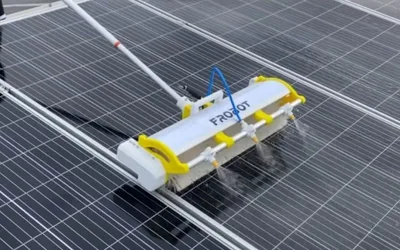
The advantage of robotic cleaning is not magic technology; it is repeatability. A well-designed panel cleaning robot:
- Carries its weight on the frame and rail line rather than the glass, so nobody has to step on a module.
- Holds brush pressure constant. A tired operator presses harder, a rushed one skims; a robot treats the thousandth panel exactly like the first.
- Meters its water. The ATA 120 (F120), for example, cleans up to 2016 m² per hour on roughly 350 litres of water per hour, with water switched from the remote and spread evenly through stainless 110-degree nozzles.
- Uses a wide, soft roller brush, so soiling is lifted by rotation instead of force.
- Offers an optional automatic spatula for bird droppings, which removes the reason people climb onto modules to scrape hardened residue.
Our comparison of manual and robotic methods goes further into which approach suits which type of site.
Document every cleaning
In a warranty dispute the strongest position belongs to the party holding records. After each cleaning, keep:
- Date, time and a note of surface temperature or weather conditions.
- Method and equipment used: robot model, brush type, pressure range.
- Water source and, where available, the water analysis result.
- Before and after photographs, ideally from the same angle each visit.
- Panel-level notes on anything observed: cracks, staining, suspected delamination.
These records protect you both against the manufacturer and against your cleaning contractor. Most disputes that surface years later come down to nobody having documented who did what, and when.
Frequently asked questions
Does using a robot automatically protect the warranty?
No. A robot reduces risk when used correctly, but choose the wrong water or the wrong hour and you can still make mistakes with one. What counts is compliance with the module documentation, not the machine itself.
How can I tell whether micro-cracks have formed?
Not by looking. If you suspect damage, compare production string by string, scan for hot spots with a thermal camera and arrange an electroluminescence test if needed. EL testing is usually done in a laboratory or on site at night with dedicated equipment.
Is it ever acceptable to step on a module?
Manufacturers advise against it as a standard rule, and nobody should walk on the glass without load-distributing measures. One of the first criteria when choosing a method is whether it forces staff onto the modules at all.
Can rainwater cause a warranty problem?
Collected rainwater is usually soft in mineral terms and makes a good source. The risk is storage: water that has picked up sand or organic debris can act like an abrasive under the brush. Filter it before use.
Clean your plant without putting it at risk
Frobot manufactures and sells its own solar panel cleaning robots and also provides a professional PV cleaning service across Turkey. Our method is planned to align with the cleaning instructions module manufacturers publish: controlled water, soft brushes, no load on the glass and a photo-documented record for every visit.
Send us your panel count, array layout and location and we will work out which equipment or service plan fits your site. You can browse every model on our products page and reach us through the contact page.
Are your panels clean?
Buy our robots and brushes in credit card instalments, or request a quote for on-site cleaning.