What Is a Solar Panel Cleaning Robot and How to Choose One
Frobot Technical Team · (updated)
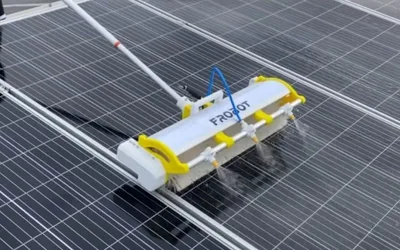
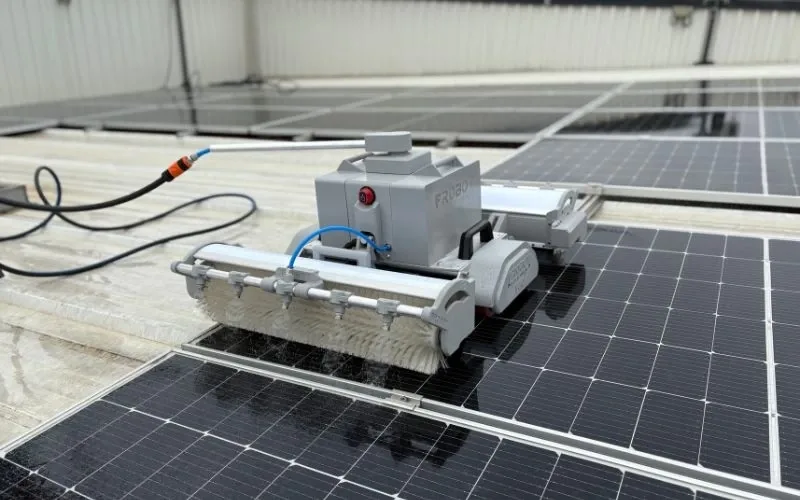
A solar panel cleaning robot is a field machine that moves across the panel surface on its own tracks, cleans with a brush and water, and is guided remotely by an operator. The aim is simple: to clean a large area in a short time, at the same quality everywhere, without sending staff onto the panels.
The market, however, offers many models with different sizes, brush structures and capabilities. The wrong choice means an investment that does not work on your site. In this guide we explain what the robot does and which criteria to look at when selecting the right model.
What does a cleaning robot do?
- It is placed on the panel surface and driven from one end of the array to the other with the remote.
- The rotating roller brush lifts the dust and residue off the glass.
- Water delivered through the nozzles carries the loosened dirt away from the surface.
- The track structure grips the tilted surface and moves without slipping.
- The operator controls the water flow, the travel direction and the brush height from the remote.
This both increases the working speed and removes the person-to-person variation in cleaning quality.
Eight criteria to check when choosing a robot
1. Brush width
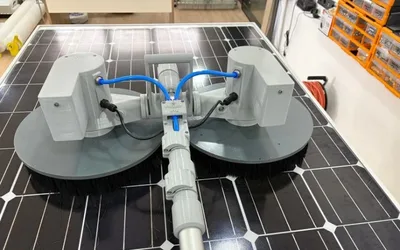
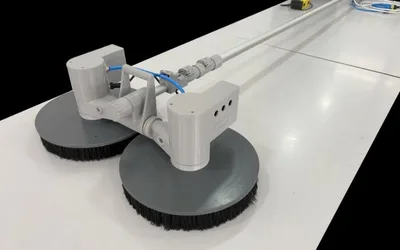
The wider the brush, the more area is cleaned in a single pass. A wide brush shortens the work on large sites, while a narrow brush makes manoeuvring easier on irregular arrays and small roofs. Our ATA 120 model carries a 120 cm imported brush, and the ATA 80 model has 2 brushes of 80 cm.
2. Cleaning area per hour
The most practical way to compare capacity is the m²/h figure. The stated capacity is 2016 m²/h for the ATA 120 and 792 m²/h for the ATA 80. Dividing the total panel area of your site by this figure gives a rough estimate of the working time.
3. Working tilt
The maximum tilt the robot can grip must match the structure of your site. The working tilt is given as 0 to 20 degrees for the ATA 120 and 0 to 25 degrees for the ATA 80. Do not select a model before the tilt of your site has been measured.
4. Weight and portability
A robot is carried by hand on site, lifted onto roofs and moved from array to array. The ATA 120 weighs 53 kg excluding the battery and the ATA 80 weighs 33 kg. On rooftop applications and sites reached by ladder, the lighter model offers a clear advantage. Both models are easy to carry and quick to assemble on site thanks to their modular structure.
5. Battery and running time
How long the machine runs on one charge directly shapes the daily plan. Both of our models use LiFePO4 batteries; the stated running time is 3 to 3.5 hours for the ATA 120 and 2.5 to 3 hours for the ATA 80. On busy sites the spare battery option removes waiting time in the field.
6. Crossing distance between panels
To move from one panel to the next, the robot has to bridge the gap in between. The stated crossing distance is 50 cm for the ATA 120 and 25 cm for the ATA 80. If the gaps on your site are wider than these values, the working plan is built accordingly.
7. Water consumption and control
Water can be the scarcest resource on site. Consumption is stated as roughly 350 l/h for the ATA 120 and roughly 300 l/h for the ATA 80. Both models have water on and off control on the remote, so water is only used while cleaning is actually taking place.
8. Service, spare parts and warranty
The most critical property of a field machine is how quickly it can be fixed when it breaks down. With imported products, spare part and service times can stretch. Frobot robots are entirely locally manufactured, every consumable and service option is available, and the ATA 120 and ATA 80 come with a 2-year warranty.
ATA 120 or ATA 80?
When does the ATA 120 (F120) fit?
It stands out on sites with wide arrays, regular layouts and high panel counts. With a 120 cm brush width and 2016 m²/h capacity it completes large areas in a short time. The optional bird dropping scraper attachment, controlled from the remote, removes stubborn stains without damaging the panel; this feature makes a real difference on sites with heavy bird activity.
When does the ATA 80 (F80) fit?
Its easy-to-carry structure gives it the advantage on rooftop systems and hard-to-reach sites. With a weight of 33 kg, a 25 cm crossing distance between panels and a working tilt of 0 to 25 degrees, it works comfortably in tighter areas. On small and mid-size sites it is enough on its own, while on large sites it can be used alongside the ATA 120 as a complement.
Both models are locally manufactured, modular in structure, and brushes in different lengths can be produced on request.
Information to prepare before choosing
- Total panel count and approximate panel area
- Installation type: ground-mounted, industrial roof, house roof or mixed
- Panel tilt and array width
- Crossing distances between panels
- Access route to the site and how the robot will be carried
- Water source and pressure conditions
- The number of cleanings you plan per year
An assessment based on this information reveals both the right model and a realistic working plan.
Let us determine the right model together
Share the dimensions of your site and we will clarify which model suits you. You can find the full technical specifications on the ATA 120 (F120) and ATA 80 (F80) pages, and see field applications in our gallery.
For orders and quotations you can use our contact page, and when you are ready you can send your request through the order page.
Frequently Asked Questions
Is special training needed to operate the cleaning robot?
The robots are operated with a 9-channel remote and the basics are learned quickly. At delivery we brief you on operation, maintenance and brush settings.
Does the robot damage the panel?
The brushes are selected to suit the panel surface and the brush height can be adjusted from the remote. Set correctly, the robot cleans without harming the glass.
Can the robot work in any condition?
Operation is not recommended in strong wind, frost or during the midday hours when the panel is extremely hot. The best time for cleaning is early morning and late afternoon, while the surface is cool.
Should I choose the ATA 120 or the ATA 80?
On large sites with wide, regular rows, the ATA 120 with its 2016 m²/h capacity stands out. On rooftops and hard-to-reach sites, the ATA 80 works more comfortably with its 33 kg weight and 0°–25° working tilt.
Can I see the result before buying a robot?
A cleaning service carried out on your site lets you see the result of the robot directly. Many of our customers start by buying the service and then move on to a robot investment for their own team.
Are your panels clean?
Buy our robots and brushes in credit card instalments, or request a quote for on-site cleaning.