Types of Solar Panel Soiling and Their Effects on Output
Frobot Technical Team ·
The phrase "the panels are dirty" covers at least eight completely different situations. Wind-blown dust and a bird dropping behave nothing alike on module glass, hit output through different mechanisms and demand opposite responses. One spreads a thin film across the whole surface; the other creates a hard, opaque, localised shadow.
That distinction matters, because operators who get cleaning right plan around the type of soiling rather than the amount. This article walks through the main categories found on solar arrays, how each hits output, and the correct field response.
Two mechanisms of loss
Every type of soiling causes damage in one of two ways.
- Uniform film loss: dust, pollen and fine particulate spread across the whole surface. Output falls proportionally, no significant temperature gradient develops, and the loss is fully recoverable through cleaning.
- Localised hard shading: bird droppings, leaves and mud splashes block light completely in one spot. The shaded cell stops producing current, behaves like a resistor in its series string and heats up. This is the classic hot spot, and it can damage cells permanently.
Put simply, uniform soiling costs revenue while localised soiling costs hardware, which is why localised contamination always needs faster intervention. We put figures around the revenue side in our article on efficiency losses from dirty panels.
Dust and soil
Dust is the most common form of soiling. Dry dust sits loosely and partly blows away, but once dew, fog or light rain hits it, it bonds to the glass and dries as a thin mud film. Rows beside unpaved roads foul noticeably faster than rows in the centre of the same plant.
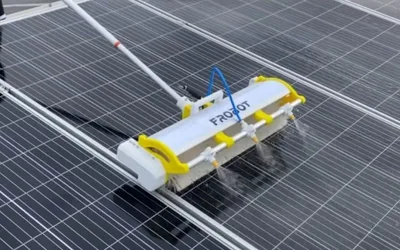
The correct response is periodic washing at an interval matched to the region. Where dust has bonded hard, wetting the surface and allowing a short dwell before brushing is safer for the glass and more efficient with water. A soft brush and controlled flow are enough; high pressure is neither needed nor wanted.
Pollen
Pollen arrives in spring and is fine enough to be invisible from a distance. Combined with moisture it forms a sticky, yellowish, uniform film, so the array still looks acceptable while output quietly slides. Sites bordering woodland or grassland carry the load for weeks.
Because pollen is sticky it resists dry brushing and must be softened with water first. Timing beats effort: cleaning during peak flow is undone within days, whereas one thorough clean afterwards holds for the season.
Bird droppings
This is the most damaging contamination on a module surface. It blocks light entirely, hardens rapidly in the sun and bonds to the glass, and it triggers hot-spot risk directly. A single cell shaded for long enough produces measurable loss across the whole string. Droppings concentrate near transformers, poles, fences and overhead lines.
Intervention has two steps: soak generously to soften the deposit, then lift it with a scraper that will not harm the surface, because scraping a dry deposit scratches glass. Our ATA 120 (F120) offers an optional remote-controlled bird-dropping scraping attachment (spatula), letting the operator clear hardened deposits under control without climbing onto the array. Details are on the ATA 120 product page.
Soot and industrial particulate
Near industrial zones, busy highways, asphalt plants and areas where coal heating is common, module glass collects a dark, oily particulate. This is not ordinary dust: because it is oily it clings chemically to the surface and barely rinses off in rain. Worse, it attracts further dust and accelerates the soiling cycle.
These sites need a shorter cleaning interval than average, and water quality becomes critical, because mineral-free water bonds far more effectively with an oily film and removes the need for detergent. Our article on water quality in panel cleaning goes into detail.
Sand and sandstorms
Sand differs from dust in two ways: the grains are larger and abrasive. Grains left on the glass after a sandstorm create irreversible micro-scratches if someone brushes carelessly.
The correct method is to flush the coarse grains away with plenty of water before any brush touches the glass. Brushing always follows wetting, never precedes it, and bristles should be checked for trapped grit between rows. Post-sandstorm cleaning belongs outside the normal calendar, as an unscheduled extra visit.
Agricultural residue
Chaff and soil thrown up during harvest, fertiliser particles and spray drift are the defining problem for plants bordering farmland. This soiling arrives as a mix of uniform film and localised residue, and spray drift in particular is sticky and stubborn.
Align the cleaning calendar with the local agricultural calendar: one visit scheduled immediately after harvest returns more than two at arbitrary dates. We expand on that logic in our annual maintenance calendar guide.
Moss and lichen
In humid climates and on low-tilt installations, organic sediment collects along the bottom edge of each module and eventually gives moss and lichen a foothold. This growth does more than shade cells: it blocks the frame drainage gaps, traps water and stains permanently.
Once established, moss will not come off in a single wash; it needs wetting, dwell time and several soft brush passes. Prevention is the real answer, and clearing bottom-edge sediment on the autumn visit stops moss before it starts. Rooftop arrays see it more often, because of low tilt and nearby trees.
Snow and ice
Snow usually sheds by itself and rarely causes lasting harm. The real risk appears during partial melting: snow that melts during the day refreezes at dusk as a band of ice along the lower module edge, and that band behaves exactly like permanent localised shading.
Intervention must be gentle. Never chip ice with hard tools, never pour hot water onto cold glass and never use salt-type chemicals; thermal shock damages glass and frames permanently. A suitable scraper used carefully is the correct approach.
Frequently asked questions
Which type of soiling needs the fastest response?
Bird droppings. They block light completely and trigger hot-spot risk directly, so they should be removed without waiting for the next scheduled clean.
If the panels look clean, can we skip cleaning?
No. Pollen and fine dust films are invisible from a distance yet still cut output. Decide from production data, not from appearance.
Does scraping hardened deposits damage panels?
Dry scraping with a hard tool does. Soak first, then use a scraper designed for module glass. The remote-controlled scraping attachment offered for the ATA 120 is built precisely for this task.
What equipment suits a small array?
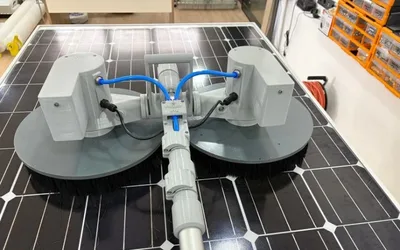
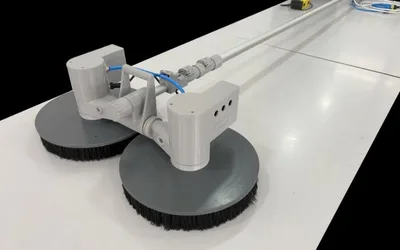
For a limited number of modules, the ATA DISK35 twin-disc battery brush or a telescopic ATA M60 roller brush is a practical answer. Module count, mounting type and the soiling you face drive the choice.
Let us identify the soiling on your site
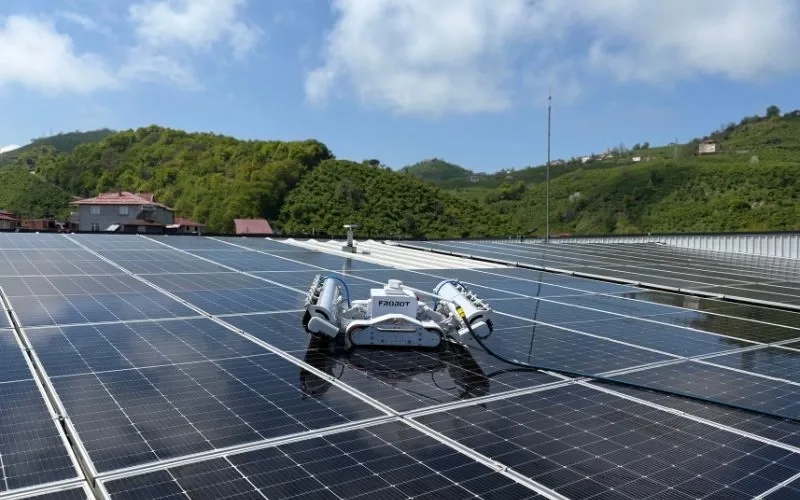
Reading the soiling type correctly changes both your cleaning interval and your equipment choice. The robots and battery brushes we manufacture in Ordu are built around soft brushes and controlled water flow that suit module glass.
Share your location, surrounding conditions and module count, and we will help you work out what you are dealing with and what programme it calls for. If you prefer to outsource, ask about our PV cleaning service through the contact page.
Are your panels clean?
Buy our robots and brushes in credit card instalments, or request a quote for on-site cleaning.