Solar Panel Cleaning Robot Maintenance: A Practical Guide
Frobot Technical Team ·
A solar panel cleaning robot is a rugged machine that will work for years when it is treated well. But like any equipment that spends its days in water, dust and lime, it needs a routine. How many seasons a robot lasts is rarely decided by the power of its motor; it is decided by whether the operator spends ten minutes on it at the end of each job.
This guide covers the daily, seasonal and annual maintenance of the ATA 120 and ATA 80 robots. Most of it applies to both machines; where the two differ, we say so.
The end-of-job routine
The most important part of maintenance is also the simplest: never put the robot away dirty and wet. A short routine before you leave site prevents most of the faults that would otherwise end up on a service bench.
- Rinse the brush and the body. Dust lifted off the glass stays trapped in the bristles as mud; once dry it stiffens them and is carried straight back onto the next panel. A quick rinse with clean water is enough.
- Drain the water lines. Water left in hoses, fittings and the manifold leaves lime deposits and can freeze on a cold night. After shutting the water off, make sure the line empties completely.
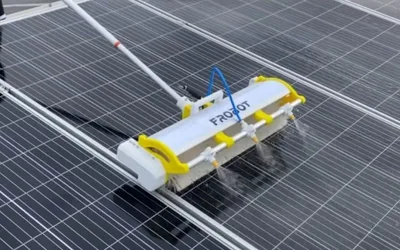
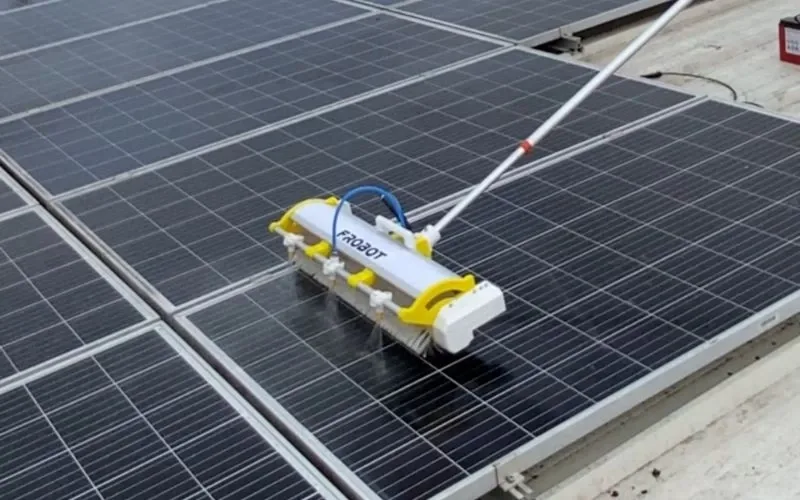
- Check the nozzles. The ATA 120 carries 14 and the ATA 80 carries 10 stainless 110 degree nozzles. In hard water areas lime builds up at the nozzle mouth, and once the spray pattern breaks down part of the panel gets brushed before it is wetted. Inspect the pattern and soak any blocked nozzle in a descaler.
- Wipe the track surface. Sand and mud stuck to the rubber-flex track reduce grip and risk carrying hard particles onto the glass.
- Dry the body. Pay particular attention to the battery bay and the connector area.
Brush and roller wear
How to recognise a worn brush
The brush is the only part of the robot that touches the panel, which also makes it the fastest wearing part. The ATA 120 uses a single 120 cm imported brush and the ATA 80 uses two 80 cm brushes; both have a brush diameter of 15 cm. That diameter is the most practical way to track wear: note it once when the brush is new, then measure the same point during the season.
- Noticeably shorter bristles and a visibly reduced diameter mean the brush is finished.
- Bristles permanently laid over in one direction no longer spread contact pressure evenly.
- If one end is more worn than the other, the robot is sitting at an angle. Check the height setting and track tension.
- Grains of sand lodged between the bristles mean the brush is now sanding rather than cleaning.
A worn brush creates two separate problems. First, contact area and pressure drop, so the panel is not cleaned properly. Second and more serious, hard particles trapped in the shortened bristles rub directly against the glass and create a scratch risk. A worn brush does not only clean worse; it can cause damage. Running one to its absolute limit is not economical, it is risky.
Replacement and keeping spares
Brushes, bearings and nozzles are consumables, not permanent parts. When you replace a brush, clean the shaft and the seats, and renew any bearing that feels loose. A single lost day in mid-season disrupts a whole cleaning programme, so keep a set of spare brushes, bearings and nozzles on site.
LiFePO4 battery care
Both robots run on LiFePO4 batteries. The ATA 120 uses two batteries of 7 kg each for 3 to 3.5 hours per charge, while the ATA 80 runs 2.5 to 3 hours on a single 4 kg battery. LiFePO4 chemistry is forgiving, but a few simple habits extend its life considerably.
- Avoid deep discharge. Watch the voltage indicator during the job; rather than running the pack down to nothing, finish the pass when the indicator starts dropping and put it on charge.
- Charge at the end of the job. Leaving an empty pack overnight is the habit that shortens life fastest.
- Store at a middle charge level. For long periods out of use, store the battery neither full nor empty and give it periodic top-up charges.
- Respect temperature limits. Do not charge below freezing. In cold weather bring the battery indoors, let it reach room temperature, then connect the charger. Avoid charging on a surface baking in direct sun.
- Inspect connectors. Never connect with wet hands, and stop using any connector showing corrosion or heat marks until service has seen it.
Transmitter and receiver care
Both robots are operated with a 9-channel Radiolink transmitter, which also controls water on and off and brush height. The remote looks like a minor accessory, but a surprising share of lost site hours start there.
- Fit fresh transmitter batteries at the start of the season and carry a spare set in the vehicle.
- Do not leave the transmitter exposed in damp or dusty conditions; store it in its case.
- Never bend, crush or tape the receiver aerial to the metal body; its position directly affects range.
- Each season, run a range test on the ground before the robot goes onto a panel.
Motors and drive
The ATA 80 uses 130 W brushless motor technology. Brushless motors are easy to live with, but the drive still needs a regular look. Working speed is 0 to 28 m/min on the ATA 120 and 0 to 22 m/min on the ATA 80; a change in the sound, pulling to one side, or unusual heat are all early warnings. Check track tension several times a season too: a loose track slips on gap crossings, the hardest moments for the drive, with the ATA 120 crossing up to 50 cm and the ATA 80 up to 25 cm.
Hoses, fittings and pump
The ATA 120 uses roughly 350 litres of water per hour and the ATA 80 roughly 300, and delivering that flow depends on the whole line staying clear. Check the intake filter on every site, renew any seal that drips, and replace hose that has started to crack rather than waiting for the end of the season. Water hardness directly determines nozzle life, and our article on water quality in solar panel cleaning covers that in detail.
Winter storage
How you close the season determines how the next one opens. For winter storage, work through the following:
- Wash the robot thoroughly and dry it completely.
- Empty the water line, pump and nozzles fully; a single pocket of trapped water can freeze and crack a fitting.
- Remove the brush, clean it and store it so nothing presses on the bristles.
- Separate the batteries, store them in a dry space that never freezes, and top them up periodically through the winter.
- Keep the robot in a dry, enclosed space under a cover rather than a damp store or a container.
- Before the first job of the new season, run a full function test on the ground: drive, brush rotation, spray pattern, height adjustment and range.
Keep a maintenance log
The log is worth almost as much as the maintenance. A simple notebook will do: date, site cleaned, running hours, water used, checks performed, parts replaced, and anything unusual you noticed. With that record you know rather than guess how many hours a brush lasts and how many spares to budget for next season. If you ever raise a warranty claim, a consistent log is your strongest supporting document.
When to call service
Owner maintenance has a clear boundary: motors, gearboxes, electronic boards, the receiver module and battery management are service work. The ATA 120 and ATA 80 carry a 2-year warranty, and opening those parts during that period is both risky and unnecessary. Weight matters too: the ATA 120 weighs 53 kg without batteries and the ATA 80 weighs 33 kg, so roof work needs proper lifting arrangements and a two-person crew. If you would rather not run the equipment yourself, our professional cleaning services cover the whole of Turkey.
Frequently asked questions
How often should the brush be replaced?
There is no fixed interval; brush life varies considerably with the character of the soiling and the water used. The right approach is measurement, not the calendar: check the diameter regularly and replace the brush when you see clear reduction, stiffening or one-sided wear.
Does the robot really need rinsing after every job?
Yes. A short rinse stops mud drying hard in the bristles and stops today's dirt travelling onto tomorrow's panels. It is the highest-return step in the routine.
Can I leave the battery on charge all winter?
Better to store it at a middle charge level with periodic top-ups than to leave it permanently connected. Make sure the storage space never drops below freezing.
How do I spot a damaged spray pattern?
Run the robot on dry ground and watch the spray from the side. If one fan is narrower, angled or dripping compared with the others, that nozzle has scaled up.
We stand behind your robot
Every robot we build in Ordu Altinordu carries our own support behind it. For spare parts, consumables and technical help just get in touch, and see the full range on our products page.
Planning a new machine? Send your requirements through the order page; if you would rather buy the service than the equipment, reach us on our contact page or call 0452 777 07 17.
Are your panels clean?
Buy our robots and brushes in credit card instalments, or request a quote for on-site cleaning.