Solar Panel Cleaning FAQ: 15 Questions Answered Clearly
Frobot Technical Team ·
Solar panel cleaning raises the same questions for almost everyone who owns a PV system. The homeowner commissioning a new rooftop array and the operator running a utility-scale farm end up wrestling with the same basics: how often, with what water, by what method, and who should do the work?
Below are the 15 questions we hear most often from customers and on site visits, each answered briefly and directly. Where a topic deserves more depth, we have linked to the relevant guide.
The basics
1. How often should solar panels be cleaned?
There is no universal interval. Frequency depends on the dust load in your region, rainfall patterns, module tilt and nearby sources of soiling. Sites next to farmland, construction or industry need cleaning more often. The practical approach is to track production through the first year and derive your own soiling curve. We cover this in detail in how often panels should be cleaned.
2. Does rain clean solar panels?
Only partly. Rain removes loose surface dust but not bonded dirt, bird droppings, oily particles or moss. It often carries the dirt down to the lower edge of the module and leaves a mud line there. Because that line permanently shades the bottom row of cells, rain sometimes makes the problem more visible rather than less.
3. How much output does soiling cost?
The loss varies with region, season, module tilt and time since the last clean, so quoting a fixed figure would be misleading. What is certain is that the loss is not linear: it accelerates as the layer thickens. Localised shading also limits the current of a whole series-connected cell string, so a small stain can cause a disproportionate drop. Our guide on soiling losses explains how to measure it.
4. How do I know it is time to clean?
Production data is the most reliable signal: a string lagging its neighbours under similar irradiance often points to soiling. Visible clues follow, including a dust film on the glass, a mud line along the lower edge, bird dropping stains and moss growth. A quick thermal camera scan also reveals localised soiling.
Method and equipment
5. What is the best time of day and season to clean?
Early morning, late afternoon or an overcast day are best; the point is to work while the glass is cool. Spraying cold water onto a module heated by midday sun creates a thermal shock risk. For season, your local soiling calendar decides: the end of pollen season, the period after harvest and the middle of long dry spells are usually sensible windows.
6. Can I use tap water?
It depends on hardness. Mains water high in calcium and minerals leaves a white film on the glass as it dries, and that film blocks light and gets harder to remove over time. In hard-water areas, softened, demineralised or collected rainwater is the better choice.
7. Is detergent safe on solar panels?
The general rule is to use no chemicals at all. Alkaline or acidic cleaners and abrasive products can permanently damage the anti-reflective coating on the glass, and they appear in most manufacturers' warranty exclusions. For exceptional cases such as stubborn oil or resin, check which products your module manufacturer approves and always rinse thoroughly with clean water.
8. Can I use a pressure washer?
High-pressure washing is not recommended. A pressurised jet can drive water past the seal between frame and glass into the laminate, and concentrated on a small area it puts a mechanical load on the glass. Manufacturers define a maximum pressure in their manuals and exceeding it is a warranty exclusion. The correct method combines controlled low-pressure water with a soft rotating brush.
9. Manual or robotic cleaning: which is better?
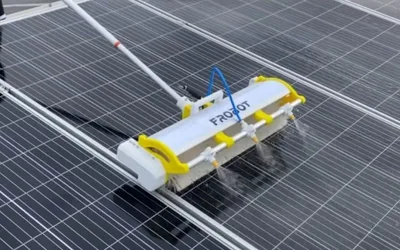
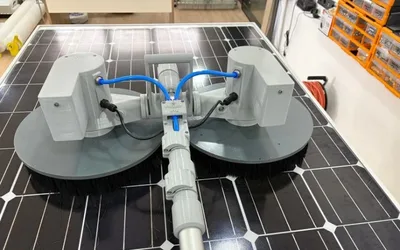
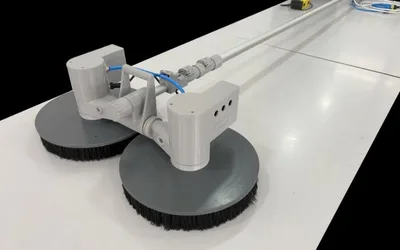
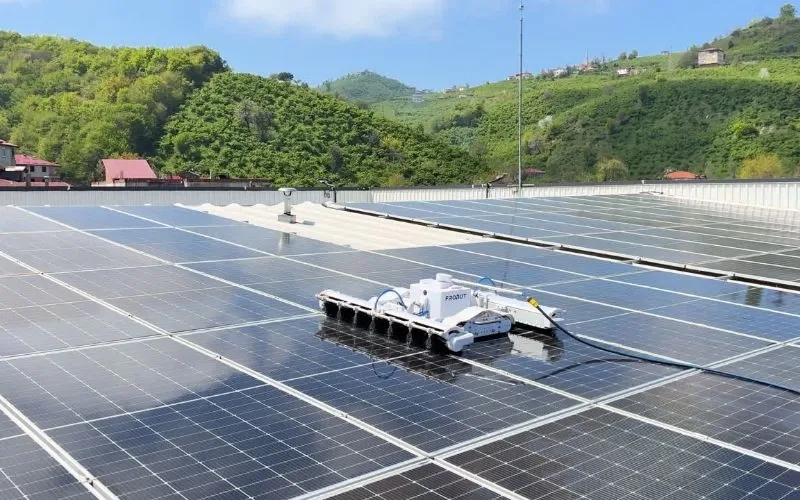
It depends on scale. On small, easily accessed systems a battery brush on a telescopic pole is sufficient and economical. As panel counts rise, labour, time and repeatability push the decision towards robotics; a robot treats the thousandth panel exactly like the first. Our manual versus robotic comparison works through the trade-offs.
10. How should I remove bird droppings?
Never scrape them dry and never use a metal blade; both scratch the glass. The correct method is to wet the area first so the residue softens, then lift it gently with a soft brush. For hardened deposits our robots offer an optional automatic spatula, which removes any reason to climb onto the modules.
Service, equipment and cost
11. Do I need a robot for a small rooftop system?
No. On rooftops with a few dozen modules, battery-powered brushes are usually the right answer. The ATA M60 single roller, for example, weighs 4.5 kg with a 50 cm brush and runs 9-10 hours on one LiFePO4 battery, reaching the array through a 2-6 m telescopic pole without anyone stepping on the glass. Our guide on brush or robot compares the criteria.
12. How long does cleaning take?
Panel count, site access and equipment decide the answer. As a reference point, the ATA 120 (F120) has a cleaning capacity of 2016 m² per hour and the ATA 80 (F80) 792 m² per hour. Water refills, transport between arrays and repositioning add to that, so real site time always exceeds theoretical capacity.
13. Should I buy equipment or hire a service?
Panel count, cleaning frequency and whether you have an in-house team decide it. For small and mid-sized sites cleaned a few times a year, hiring a service is usually more practical. For large plants in dusty regions that need frequent cleaning, owning the equipment becomes the better economics over time. Model your annual number of cleans, your labour cost and the expected service life of the equipment together before deciding.
Safety and warranty
14. Is it safe to walk on solar panels?
No. Standing or kneeling on a module bends the glass and the silicon cell beneath it, which can create micro-cracks invisible to the eye. Those cracks widen over months, causing output loss and hot spots. Manufacturers advise never stepping on modules, and whether a method forces staff onto the glass is one of the first questions to ask.
15. Does cleaning void the panel warranty?
Cleaning done correctly does not void it, and most manufacturers treat regular cleaning as part of your maintenance duty. What puts the warranty at risk is high pressure, abrasive chemicals, stiff brushes, standing on modules and thermal shock. Read the cleaning section of your own module manual and document every clean with a date, method note and photographs.
If your question is not on the list, ask us
Frobot manufactures solar panel cleaning robots and battery-powered cleaning brushes in Ordu, Turkey, and also provides a professional PV panel cleaning service nationwide. Once we know your panel count and array layout, we can tell you clearly which solution fits your site.
Browse the range on our products page, review field cleaning on our services page, and send any remaining questions through our contact page.
Are your panels clean?
Buy our robots and brushes in credit card instalments, or request a quote for on-site cleaning.