How Much Efficiency Loss Does Solar Panel Soiling Cause?

Frobot Technical Team ·
Solar power plants look like systems that simply run themselves once they are commissioned. Yet a panel has only one job: to turn the light falling on it into electricity. Every speck of dust and every bird dropping that stands in the way of that light is a direct production loss. This is why solar panel cleaning is not a cosmetic detail but a measurable revenue item.
In this guide we look at why panels get dirty, how far soiling can push output down, how to spot the loss on site, and how a cleaning plan affects the return on your investment.
Why do solar panels get dirty?
Panels sit outdoors, usually on a tilted plane and in a fixed position. That means the glass is permanently exposed to environmental load. The main sources of soiling are:
- Dust and soil: Fine dust carried by the wind combines with dew and rain and leaves a sticky layer on the surface.
- Bird droppings: Localised but the most damaging type of soiling; it blocks light completely and hardens onto the glass over time.
- Pollen and organic residue: Peaks in spring and forms a light-scattering film together with moisture.
- Agricultural soiling: Straw dust, fertiliser and spraying particles that drift across the site during harvest periods.
- Industrial and traffic particles: Plants beside busy roads or inside industrial zones collect soot and oil-based deposits.
- Snow, ice and moss: In humid climates the residue that builds up along the lower edge of the panel frame turns shading into a permanent problem.
How much output does soiling cost?
Quoting a single number would be misleading, because the loss depends on the region, the panel tilt, the rainfall pattern and the time that has passed since the last cleaning. Even so, industry research and field measurements generally point to a production loss of 10 to 30 percent on systems that are not cleaned regularly. In arid, dusty regions and on sites bordering farmland, the upper end of that range is reached and sometimes exceeded.
An important feature of this loss is that it is not linear. In the first weeks a thin dust layer costs a few percentage points, but as the layer thickens and turns muddy with rain, the loss accelerates. In other words, the longer cleaning is postponed, the more disproportionately the lost kilowatt-hours grow.
Why does a small stain cause a large loss?
A panel is made up of cells connected in series, and in a series circuit the weakest cell sets the current. When a localised shadow such as a bird dropping covers a single cell, the current of the entire string that cell belongs to drops. That is why a stain covering only 2 to 3 percent of the panel area can cause a far larger fall at the panel output.
The same mechanism also heats the shaded cell. A cell that cannot generate electricity converts the current passing through it into heat. When this continues for a long time it is called a hot spot, and it can leave permanent damage on the panel. Soiling therefore threatens not only today production but the service life of the panel itself.
How do you spot the loss on site?
Efficiency loss is usually silent: it raises no alarm, it simply shows up as a lower figure in the production report. The following methods make it visible:
- Compare inverter data: Put today against earlier days with similar irradiation. If output falls while the weather is unchanged, soiling is the likely cause.
- Look for string-level differences: When some strings on the same site produce clearly less than others, that points to soiling or shading in that area.
- Watch the jump after rain: A visible rise in production after rainfall is concrete proof of soiling-related loss.
- Use a reference panel: Cleaning one panel and comparing it with its neighbour on the same day gives a practical sense of the size of the loss.
- Check with a thermal camera: Hot spots reveal both stubborn stains and the cells that are already at risk.
How does cleaning affect the return on investment?
The payback calculation of a solar investment is built on the forecast annual production. If output stays below expectations the payback period stretches, and the total energy lost over the life of the system can add up to a significant share of the initial investment. Regular cleaning is the lowest-cost intervention that reverses this picture.
A cleaning visit is also an opportunity to inspect the site. Loose clamps, crushed cables, cracked glass or corroded mounting parts are spotted while the work is being done. A small maintenance item is therefore solved before it turns into a major fault.
Practical steps to reduce soiling
- Do not let tall vegetation grow under and around the panels; it reduces the source of dust and organic residue.
- Apply deterrent solutions to poles, wires and mounting ends where birds perch.
- Keep the cleaning interval shorter for the strings closest to unpaved roads.
- Where the tilt is low and close to horizontal, self-cleaning by rain is weak; shorten the interval on those sites.
- Schedule cleaning early in the morning or late in the afternoon, while the panel surface is still cool.
Frequently asked questions
Does rain clean the panels?
Rain removes part of the loose dust, but it does not lift bonded dirt, bird droppings or oily particles. In most cases rain carries the dirt to the lower edge of the panel and leaves a band of mud there. Because that band permanently shades the bottom row of cells, rain sometimes makes the problem more visible rather than solving it.
Can soiling losses be recovered?
Yes. Losses caused by dust and organic soiling are largely recovered after cleaning carried out with the right method. However, if a hot spot has already caused permanent damage inside a cell, that loss never comes back. This is the strongest argument for not postponing cleaning.
Does cleaning damage the panel?
Not when it is done with the right equipment. Damage comes from wrong methods such as high-pressure water, hard brushes, abrasive detergents or cold water applied to a hot panel. Systems that use a soft brush suited to the panel surface and controlled water flow protect the coating on the glass.
Do small rooftop systems need cleaning too?
They do. Rooftop systems are usually installed at a lower tilt and self-clean poorly. Chimneys, ventilation outlets and nearby trees also make organic soiling heavier on roofs.
Recover the real output of your panels
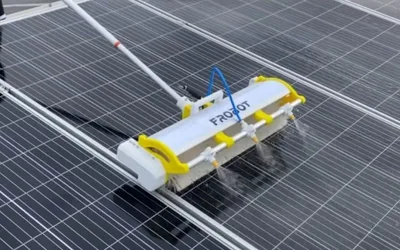
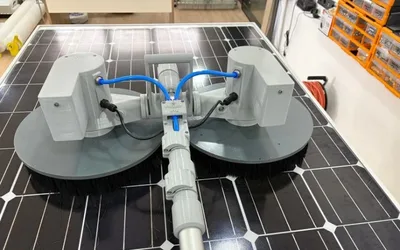
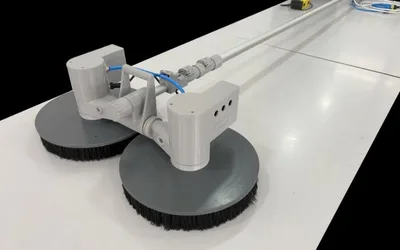
At Frobot we both manufacture our own solar panel cleaning robots and provide a PV plant panel cleaning service across Turkey. If you prefer to manage the site with your own team, take a look at our ATA 120 (F120) and ATA 80 (F80) models; if you would rather leave the cleaning to us, share your site details and request a quotation.
Tell us your panel count, your location and your array type, and we will build the right cleaning plan for your site together. You can reach us through our contact page and see every equipment option on the products page.
Are your panels clean?
Buy our robots and brushes in credit card instalments, or request a quote for on-site cleaning.