Solar Panel Cleaning Methods: Manual or Robotic Systems?
Frobot Technical Team ·
There is no single method for solar panel cleaning. The range runs from a simple bucket and brush all the way to remote-controlled robots. The right choice depends on the size of the site, the access conditions, the water source and how often you clean.
In this article we compare the main cleaning methods and explain, with clear criteria, which solution makes sense on which site.
1. Classic manual cleaning
This is the best known method: brush, sponge, telescopic pole and hose. On small rooftop systems and installations of only a few panels it is still a reasonable solution.
- Advantages: The investment cost is very low, the equipment is easy to find, and on small areas the work starts immediately.
- Disadvantages: It is labour intensive, the duration grows quickly on large sites, cleaning quality varies from person to person, and parts of the panel can be missed.
- Risks: The wrong brush can scratch the glass, high-pressure water can strain the sealing, and occupational safety risk rises on tilted and elevated surfaces.
2. Battery-powered motorised brushes
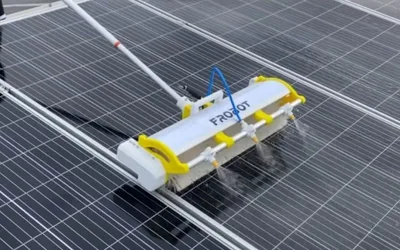
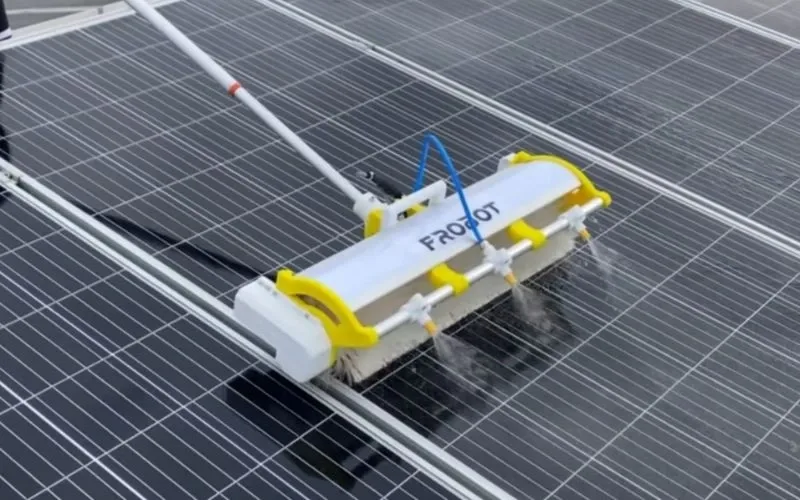
Cleaning with motorised roller or disc brushes mounted on a telescopic pole is the advanced version of the manual method. The operator stays on the ground while the brush moves across the panel.
- Advantages: Much faster and far more uniform than manual cleaning, and the operator never has to climb onto the panels. Battery-powered models remove any dependence on a power line.
- Where it fits: Ideal for narrow gaps a robot cannot cross, irregular arrays, edge rows and small-scale sites.
- Its limit: An operator still has to work continuously, so on very large sites the total labour requirement stays high.
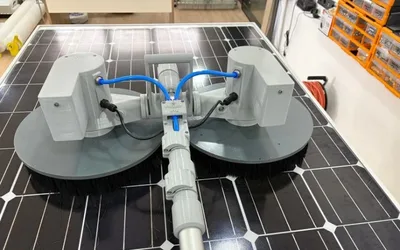
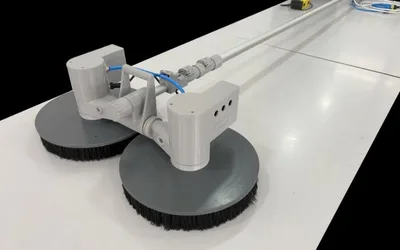
The Frobot product family covers this category with locally produced single-roller, double-roller and twin-disc brush options. These are preferred especially in areas where robots cannot operate.
3. Robotic cleaning
A remote-controlled cleaning robot travels across the panel surface on its tracks and cleans with a brush and controlled water spray. The operator guides the robot from the site and never touches the panel.
- Speed: The area cleaned per hour is many times that of the manual method. The cleaning capacity of our ATA 120 model is stated as 2016 m²/h and that of the ATA 80 as 792 m²/h.
- Consistency: The robot works with the same pressure and the same speed on every panel, so quality differences caused by people disappear.
- Safety: Staff no longer need to step onto the panels. On rooftop applications this is the single biggest gain.
- Water management: Thanks to the water on and off control on the remote, water is delivered only when it is needed and needless consumption is avoided.
Comparison: which method leads on which criterion?
Time and labour
On a small rooftop system manual cleaning is finished in an afternoon. But as the site grows, the duration of the manual method rises linearly and the team gets bigger with it. With robotic cleaning the same team completes a far larger area within the same day. The break-even point is usually where the site passes a few hundred panels.
Cleaning quality
With manual cleaning it is hard to reach the upper edge of the panel, the frame corners and the far rows of an array. Because the robot follows a fixed route across the panel, those areas are cleaned with the same care. The result is a more balanced production curve across the whole plant.
Risk of damaging the panel
The source of risk is usually not the equipment but the way it is applied. Hard brushes, abrasive detergents and high pressure are harmful in every method. Systems that work with soft brushes and controlled pressure are safe in both manual and robotic use. In robotic systems the brush height can be adjusted from the remote, which makes it easier to keep the pressure right on different panel structures.
Occupational safety
Working at height is the most serious risk item in the sector, and a wet panel surface is extremely slippery. In robotic applications the operator never climbs onto the panels, which removes most of that risk.
Cost
The manual method has a low initial cost and a high recurring labour cost. A robotic solution is a one-off investment that lowers the labour expense of every cleaning that follows. On a small system cleaned a few times a year the manual method may be enough, while on sites that need regular, large-scale cleaning a robot pays for itself quickly.
So which method should you choose?
- Domestic system of a few panels: A soft brush and low-pressure water are enough; check the panels a few times a year.
- Small and mid-size rooftop plant: A battery-powered motorised brush or a portable robot; decide according to access and tilt.
- Industrial rooftop: A robot is the strong option; safety and time advantages are decisive.
- Large ground-mounted plant: A robot is the core solution; keep a motorised brush as well for edges and narrow areas.
- If one or two cleanings a year are enough: Buying a professional cleaning service makes more sense than buying equipment.
Frequently asked questions
Can I use a pressure washer?
It is not recommended. High pressure strains the sealing gaskets in the panel frame and the rear-side connections, and it can damage the coating on the glass. The correct approach is low-pressure water together with a soft brush.
Does a robot work on every panel type?
Robot selection depends on the panel size, the array width, the tilt and the crossing distance between panels. The working tilt is stated as 0 to 20 degrees for the ATA 120 and 0 to 25 degrees for the ATA 80. Once you share the dimensions of your site we determine the right model together.
Should detergent be used when cleaning?
As a general rule, no. Detergent residue leaves a film on the glass and makes dust bond faster. A suitable brush and clean water are enough for most types of soiling.
Do I need both a robot and a brush?
On large sites the two complement each other. The robot cleans the main arrays quickly, while the motorised brush handles the edges and narrow areas the robot cannot reach.
Let us choose the right method for your site together
At Frobot we manufacture locally produced cleaning robots and motorised brushes, and we also provide field cleaning services. That is why we recommend the method that suits your site rather than the product we want to sell.
You can review the ATA 120 and ATA 80 robots, see all equipment options on our products page, or send your site details through the contact page to receive a quotation.
Are your panels clean?
Buy our robots and brushes in credit card instalments, or request a quote for on-site cleaning.