Battery Brush or Robot? Picking the Right Cleaning Setup
Frobot Technical Team · (updated)
Anyone who installs a small rooftop or residential PV system runs into the same question sooner or later: to keep the panels clean, should you buy a battery-powered brush or go straight to a cleaning robot? On paper they do the same job. On site they follow two completely different working logics.
This article compares the two honestly, sets out the criteria that should decide it, and says which Frobot product makes sense in which case. We will also say up front that for many small sites a third option, buying the cleaning service instead of the equipment, is the smarter answer.
Two tools, two working logics
What a battery brush does
A battery brush is held by the operator and reaches the panel through a telescopic pole. Nothing is placed on the array itself; you work from the ground, from a roof edge, or from any safe standing position. That is its biggest strength: it works on sites where a robot could never be set up at all.
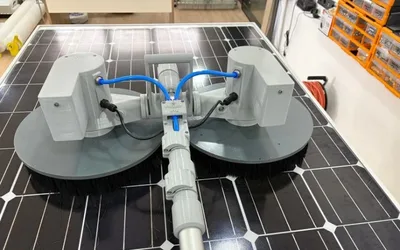
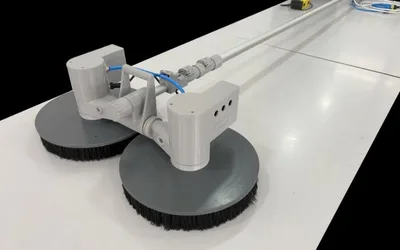
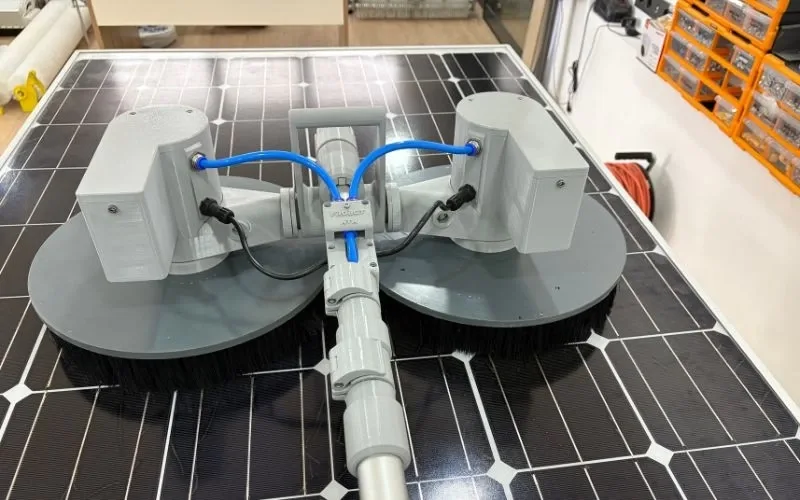
- ATA DISK35 twin-disc brush: 4 to 6 hours of uninterrupted use from a backpack LiFePO4 battery. The package includes the brush, the LiFePO4 battery, the charger and the battery backpack. The twin-disc head spreads a wide contact area over the glass.
- ATA M60 single roller: Modular, a 50 cm brush and just 4.5 kg, the lightest in its class. It runs 9 to 10 hours on a single LiFePO4 battery, the backpack battery weighs 1.5 kg, and it comes with a 2 to 6 m telescopic pole and a 1-year warranty against manufacturing defects.
- ATA M60 twin roller: Also modular and 4.5 kg, with a 60 cm brush and two rollers covering more surface per pass. It runs 3 to 4 hours on a single LiFePO4 battery, the backpack battery weighs 4.5 kg, and it ships with the 2 to 6 m pole and a 1-year warranty.
The trade-off is clear: a battery brush needs an operator for the whole job, and cleaning speed follows human pace. By the end of a long row, pressure and attention inevitably drop.
What a robot does
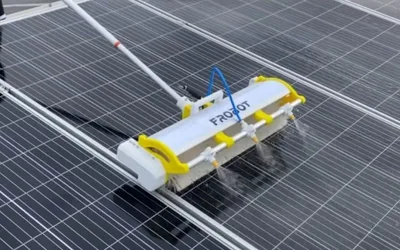
A cleaning robot is placed on the array and driven by remote control. Brush pressure is constant, travel speed is constant, water delivery is constant. Human fatigue leaves the equation. The ATA 120 has a cleaning capacity of 2016 m² per hour and the ATA 80 reaches 792 m² per hour, throughput that manual work simply cannot approach.
In exchange, the robot brings its own conditions. The array geometry has to suit it: a working tilt of 0 to 20 degrees for the ATA 120 and 0 to 25 degrees for the ATA 80, with gap crossings of up to 50 cm and 25 cm respectively. The machine also has to be placed on the panels safely, and at 53 kg and 33 kg excluding batteries, how you lift it is a real question rather than a detail.
The criteria that decide it
- Array size: On a few hundred square metres, a robot's hourly capacity is never used. Setting up and packing down takes longer than the cleaning. As the array grows, the balance swings quickly toward the robot.
- Roof access and safety: Wherever walking the roof is risky, a telescopic brush worked from the ground or a safe platform is the sensible choice. Our article on rooftop cleaning safety covers that side in detail.
- Row length: Robots shine on long, uninterrupted rows. On short, broken and irregular layouts, constant repositioning erodes the advantage.
- Tilt: On steep roofs the working tilt limit settles the argument before anything else does.
- Gaps between panels: If the gaps are wider than the robot can cross, someone has to lift it at every gap, and that pace becomes punishing fast.
- Cleaning frequency: Equipment that cleans once or twice a year mostly sits in storage. In dusty regions that need frequent cleaning, a machine earns its place much faster.
- Do you have a crew: One person can drive a robot, but getting it onto and off the array usually takes two. Without a standing crew, that is an operational burden.
- Transport and storage: A battery brush fits in a car and lives in a cupboard over winter. A robot needs proper transport, dry storage and regular battery care.
Which one for which site
Homes and small commercial roofs
On a single dwelling or a small commercial roof, the answer is almost always the battery brush. Worked with a 2 to 6 m telescopic pole to suit the height, the ATA M60 single roller is the most comfortable tool for the job thanks to its light weight and 9 to 10 hours of runtime per charge. With a few more panels, or if you want more surface per pass, the twin roller version takes over.
Mid-size roofs and heavily soiled sites
Sticky soiling, pollen and agricultural dust need more mechanical action. The ATA DISK35, with its twin-disc head and 4 to 6 hours of backpack-powered running, performs well on those surfaces.
Large roofs and ground-mount plants
Where rows are long and regular, tilt is within range and gaps are narrow, the robot wins outright. The difference in hourly capacity turns a multi-day job into a few hours. At this scale it is the ATA 120 or the ATA 80; both carry a 2-year warranty, and both allow water control and brush height adjustment from the transmitter.
The third option: buy the service
Buying equipment is not only paying a price. Charging, stocking spares, winter storage, finding an operator and carrying the safety responsibility on a roof are all part of the deal. On a small system cleaned once or twice a year, that total burden usually outweighs simply hiring the work out.
For many small and mid-size sites the most sensible route is therefore to skip the purchase and use a professional cleaning service. Owning equipment starts to make sense as panel counts rise or once you have more than one site to look after.
Let us choose the right tool together
Tell us your array size, roof type and cleaning frequency, and we will start by telling you which solution actually fits rather than which product to buy. You can compare every battery brush and robot model side by side.
If you would rather buy the work than the machine, our cleaning services operate across Turkey. For a recommendation tailored to your site, reach us through the contact page, on 0452 777 07 17 or on WhatsApp.
Frequently Asked Questions
Will a battery brush scratch the panels?
Not with the right brush, the right water and the right technique. Scratch risk almost always comes from worn bristles, from dragging dry sand across the glass, or from unsuitable attachments.
Can a robot be used on any roof?
No. Working tilt, gap width, row layout and a safe way to place the machine all have to line up; where they do not, a battery brush or a cleaning service is the right answer.
Does it make sense to own both a battery brush and a robot?
Most professional crews do exactly that. The robot clears the main surface quickly while the battery brush handles edge rows, awkward sections and anything the robot cannot reach.
What else do I need with a battery brush?
The basic package covers the brush, battery, charger and battery backpack. Beyond that, plan a suitable water source, hose arrangement and, for any roof work, proper safety equipment.
Are your panels clean?
Buy our robots and brushes in credit card instalments, or request a quote for on-site cleaning.