How to Calculate Solar Panel Cleaning Cost: A Method Guide
Frobot Technical Team ·
Quotes for solar panel cleaning can differ sharply even for the same site. The reason is usually not that one company is expensive and another is cheap; the quotes are pricing different scopes, different methods and, in effect, different jobs. The only way to compare them properly is to understand how the cost is built in the first place.
This article gives no figures at all. Instead it sets out the cost drivers and shows how to build your own model, so that you can read a quote, question it, and put a realistic budget together for your own plant.
What drives the cost
Panel area and count
Every calculation starts from total panel surface area. Panel count alone is not enough, because modules of different ratings have different dimensions. The correct approach is to multiply panel count by module surface area and work in square metres. Almost all professional pricing is built on that number; quotes given per panel make like-for-like comparison difficult.
Array type: ground-mount, rooftop, carport
The same square metre means different work on different array types. Ground-mount rows are long and regular, equipment is easy to position and the working pace is high. Rooftops add access, material handling and safety requirements. Carports add height and vehicle traffic underneath, which constrains how the crew can work. Workload per square metre diverges noticeably across the three.
Tilt and height
As tilt increases, both the safety provisions and the physical difficulty increase with it. Height is not only a safety question but an equipment question: above a certain point telescopic reach is no longer enough and a platform or a different method is required. Both reduce the surface a crew can cover per hour.
Access and mobilisation
How the crew reaches the site is one of the most decisive items and one of the least visible in a quote. Distance from the nearest city, road condition, whether the crew has to stay overnight, equipment transport, and whether a vehicle can drive between the rows all land in the cost. The gap between a site where a truck follows the rows and one where everything is carried by hand should not be underestimated. We covered that side in detail in ground-mount cleaning logistics.
Water
Water is the quiet cost item. Is there a usable source on site? If so, is its quality suitable for panel cleaning, or does it need treatment or softening? If there is none, does it have to arrive by tanker? The answers change the total fundamentally. Hard water also damages more than the equipment: it dries into visible deposits on the glass and the job has to be repeated.
Labour
Crew size multiplied by hours on site is the largest single component. That includes set-up and pack-down time, breaks and safety procedures. Rooftop work adds harnesses, lifelines, edge protection and the necessary training, and cutting that line is the worst possible saving.
Equipment and throughput
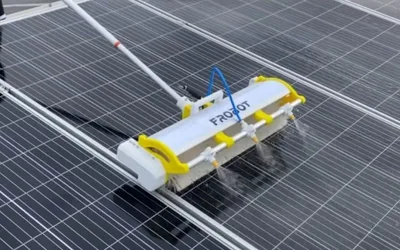
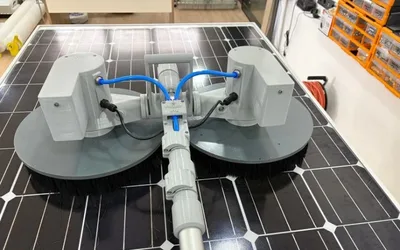
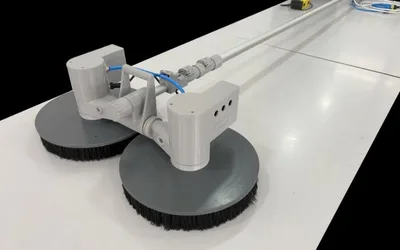
Equipment choice feeds straight into total hours, and total hours feed straight into cost. With manual cleaning the pace follows the operator. With robotic cleaning it can be measured: the ATA 120 has a cleaning capacity of 2016 m² per hour and the ATA 80 reaches 792 m² per hour. Finishing the same site in far fewer hours shrinks the labour and mobilisation lines together. On the other hand a robot does not suit every site, and forcing one onto unsuitable geometry raises the cost rather than lowering it.
Frequency and contracts
The number of visits per year is one of the strongest levers on unit cost. A one-off job loads all the preparation and mobilisation onto a single visit. Under an annual programme the same overhead is spread across several visits, the crew learns the site, the hours fall and the unit cost drops with them. Our cleaning contract checklist sets out what a contract should actually contain.
Extras
Anything outside standard cleaning should be priced separately: scraping hardened bird droppings, removing moss and organic build-up along the lower frame edge, thermal camera inspection, before-and-after measurement reporting, and photographic documentation. Some of these will be in a quote and some will not, and you need to see in writing which is which.
Build your own model
Knowing the items is not enough; they have to be put in order. A simple model that works in practice looks like this:
- Calculate total panel surface area: panel count multiplied by module surface area.
- Note the array type, tilt and height, and set a realistic working pace per square metre. This is the step where manual versus robotic gets decided.
- Divide total area by that pace to get hours on site, then add set-up and pack-down.
- Multiply those hours by crew size to reach total man-hours.
- Add mobilisation as its own line: travel, transport and accommodation if needed.
- Add the water line: source, haulage and treatment where required.
- Add the equipment line: depreciation, consumables, fuel and energy.
- Show safety provisions and extras on separate lines.
- Divide the total by the number of annual visits to reach cost per visit and cost per square metre per visit.
The value of this model is not its absolute answer but its comparability. Fill the same table in for two scenarios and you immediately see which line is actually driving the result.
Comparing offers on a like-for-like basis
The only honest way to compare quotes from different companies is to convert all of them to cost per square metre per visit. While doing that, ask for written answers to the following:
- Is the price per square metre, per panel, or a lump sum?
- Who supplies the water, and is tanker haulage included if it is needed?
- Are travel, transport and accommodation included or billed separately?
- How many visits does the price cover, and does the unit price change under an annual programme?
- Are bird-dropping scraping, moss removal and reporting included?
- What method and what water quality will be used?
- Does anything in the method affect the panel warranty, and is a report issued afterwards?
- How are insurance and site safety responsibilities arranged?
Until those are answered, two quotes cannot be compared. A price that looks low is very often the sum of what has been left out of scope.
Weighing cost against recovered production
Read on its own as an expense line, cleaning cost always looks like too much. The correct reading sets it against the production it recovers. We explained how much a dirty array gives away in our article on soiling losses, and the logic of the comparison is simple.
If the monetary value of the production recovered after cleaning exceeds what the cleaning cost, the work finances itself. When you make that comparison, spread the gain across the year, because cleaning is not an instant jump but a benefit that lasts until the next soiling cycle. The same logic applies to buying equipment, which we walk through in our return on investment analysis. In the end the question is not what cleaning this plant costs, but what leaving it dirty costs.
Frequently asked questions
Why is pricing given per square metre?
Because the real workload is proportional to the surface that has to be brushed, not to the number of modules. Modules of different ratings have different dimensions, so per-panel prices describe different jobs and cannot be compared.
Why do quotes for the same site differ so much?
Usually because of scope. Water supply, travel, bird-dropping removal, reporting and safety arrangements may be included in one quote and excluded from another. The difference only becomes visible once the items are laid out in the same table.
Does an annual contract really lower unit cost?
Yes, because preparation and mobilisation overheads are spread across several visits and hours fall as the crew learns the site. Planned cleaning also stops soiling from becoming baked-on, which makes each visit easier.
Would buying my own equipment be cheaper?
Owning equipment starts to pay as panel count, number of sites and cleaning frequency rise. On a single small site, maintenance, storage and the operator burden usually outweigh simply hiring the service.
Let us build the numbers for your site
Share your panel count, array type and location, and we will fill the items above in for your plant and present a transparent, line-by-line study. You will see what is in scope and what is not, in writing, from the start.
For the cleaning service, see our services page; if you are considering running your own equipment, browse our product range. For a quote or any question, reach us through the contact page or on 0452 777 07 17.
Are your panels clean?
Buy our robots and brushes in credit card instalments, or request a quote for on-site cleaning.