Rooftop Solar Panel Cleaning: Safety and Robot Advantage
Frobot Technical Team ·
Rooftop solar installations are growing fast in Turkey. Factories, warehouses, cold storage facilities and commercial buildings have turned their empty roofs into production areas. Cleaning a rooftop plant, however, is a different and often harder job than cleaning a ground-mounted site.
In this article we explain why panel cleaning on industrial roofs has to be treated separately, which risks come to the fore, and what robotic cleaning delivers at exactly that point.
Why do rooftop plants get dirty faster?
- Low tilt: On rooftop installations panels are usually mounted at flatter angles. That stops rain from running off quickly and makes the dirt persistent.
- Chimneys and ventilation outlets: In production facilities the exhaust, oil vapour and dust directed to the roof land straight on the panel surface.
- Nearby environment: Chimneys of neighbouring facilities, heavy traffic and construction activity increase the soot and particle load.
- Bird activity: Roof edges and panel frames are natural perching points for birds.
- Standing water: Water pooling on the roof surface combines with dust and leaves a permanent mud band along the lower edge of the panel.
As a result, rooftop plants generally need cleaning more often than ground-mounted sites in the same climate.
The real risk on a roof: occupational safety
The most critical dimension of rooftop cleaning is not technical but human. Working at height is one of the most serious causes of accidents in the sector, and panel cleaning multiplies that risk:
- Wet glass is slippery: During cleaning the panel surface becomes extremely slippery. Stepping on panels to move around is risky in any condition.
- A panel is not load bearing: Standing on a panel is not only an accident risk but also a cause of invisible micro-cracks. Those cracks turn into production loss over time.
- Roof cladding is not strong everywhere: Sandwich panels or aged trapezoidal sheeting can collapse under load. Skylight areas are particularly dangerous.
- Cables and water together: Having DC lines and water in the same place on a roof makes correct equipment and correct application essential.
- Wind effect: At roof height the wind is far stronger than at ground level and upsets balance.
The basic principle in rooftop panel cleaning is therefore clear: the time staff spend on the panels must be reduced to a minimum.
What does robotic cleaning deliver on a roof?
Staff never climb onto the panels
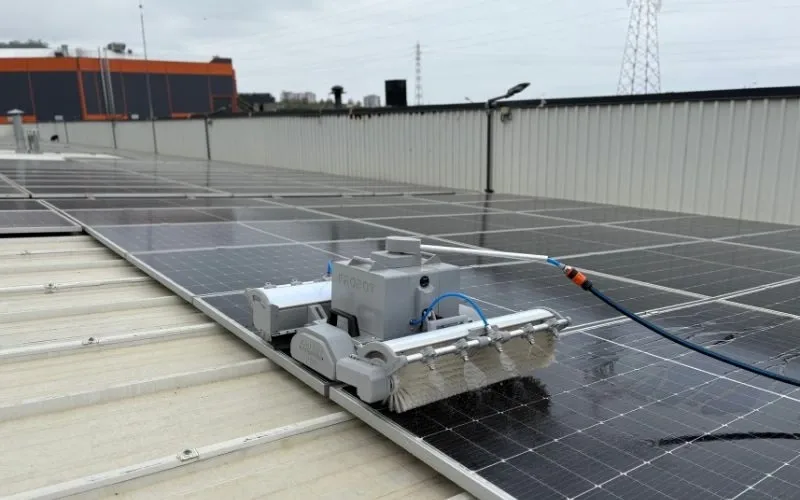
The robot is placed at the start of the array and driven forward with the remote. The operator manages the work from a safe position, which removes most of the risks arising from slipping and stepping on panels.
The work takes less time
Industrial roofs are wide, and manual cleaning can take days. With robotic cleaning the area covered per hour is far higher; the stated capacity is 2016 m²/h for the ATA 120 and 792 m²/h for the ATA 80. For production facilities this means a shorter operational interruption.
Portability matters
On a roof the equipment is lifted up by ladder, lift or crane, which makes weight and modularity decisive. The ATA 80 model, at 33 kg excluding the battery and with a modular structure, is built especially for rooftop applications; it is easy to carry and quick to assemble on site. The ATA 120, in turn, offers a speed advantage on wide and regular roofs.
Water is used under control
Water management is a separate subject on a roof; excess water can create problems for drainage and waterproofing. Our robots have water on and off control on the remote, so water is delivered only while the brush is working and only as much as needed.
It works in narrow passages
On roofs the distances between panels are usually tight. The stated crossing distance between panels is 25 cm for the ATA 80 and 50 cm for the ATA 120. The suitable model is selected according to the layout of your site.
Why is timing critical in rooftop cleaning?
In production facilities the roof is part of the operation. Ventilation units run, maintenance teams move around, and in some facilities process lines pass over the roof. Cleaning work therefore has to be planned operationally as well as technically.
The best time is usually early in the morning. The panel surface has not yet heated up, the wind is calmer than at midday, and because production has not peaked, the short shading that occurs during cleaning has little effect. Working at midday in summer creates both a thermal shock risk for the panel and a heat risk for the team on the roof.
Matching the cleaning schedule with the maintenance shutdowns of the facility also stops teams from blocking each other on the roof and makes it easier to finish the job in one go.
Checklist before rooftop cleaning
- Have the load capacity of the roof cladding and the position of skylight areas been identified?
- Has the access route (ladder, lift, crane) and the method of carrying the equipment been planned?
- Is a water source available on the roof, and if not, how will it be provided?
- Are the drainage points clear, and where will the excess water go?
- Have the wind conditions and the working hours (while the panel surface is cool) been planned?
- Have the cable connections and connectors been visually inspected?
- Is the working-at-height safety equipment ready?
Frequently asked questions
Can you step on rooftop panels?
You should not. A panel is not a walking surface; stepping on it means both an accident risk and the formation of micro-cracks in the cells. Those cracks are not visible immediately but show up as production loss over time.
How often should a rooftop plant be cleaned?
Industrial roofs generally need cleaning more often than ground-mounted sites because of chimney and soot effects. The best way to determine the right interval is to take the production values after cleaning as a reference and track the decline.
Can a robot be used on every roof?
Panel size, array width, tilt and the crossing distance between panels are decisive. Once these dimensions are shared we clarify which model is suitable; for some irregular areas, complementary work with a motorised brush is planned.
Does production stop during cleaning?
A full shutdown is usually not required. The work is scheduled for the early hours when production is low so the loss is minimised, and the plan is agreed according to the operating conditions of the facility.
Let us define the right solution for your roof
Leave the cleaning of your rooftop plant to our team, or acquire equipment for your own. You can learn about our cleaning service, or review the ATA 80 (F80) built for rooftop applications and the ATA 120 (F120) for wide roofs.
Share your roof area, panel count and access conditions through our contact page and we will build a suitable plan together.
Are your panels clean?
Buy our robots and brushes in credit card instalments, or request a quote for on-site cleaning.